Integrated report 2020


Within a constantly changing business environment, board members and executive management have a key role, and indeed a responsibility, to create value for the business and society. This requires the board and executive management to examine the company’s impact on society and how it could make a positive difference in the communities where Exxaro operates by embedding societal values deep into our core purpose, strategy and everyday decision-making. This was further strengthened through the group’s corporate governance framework, structure and processes the board created to oversee sustainability matters including reporting and accountability. Performance and sustainability are fully integrated in the achievement of value over time.
Our board of directors is accountable for Exxaro’s governance and performance, balancing the company’s interests as a responsible corporate citizen with the legitimate needs and expectations of stakeholders.
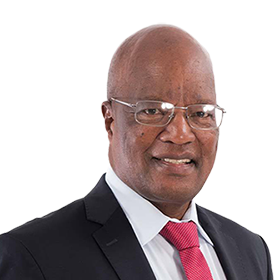
Jeffrey van Rooyen
(70)
Jeffrey is a director of various companies in the Uranus group, non-executive director Pick n Pay Stores. He is a former chairperson of the Financial Reporting Standards Council, a former trustee of the International Accounting Standards Foundation and member of the University of Pretoria’s faculty of economic and management sciences’ oversight board. He was a partner at Deloitte, chairperson of the Public Accountants and Auditors Board, CEO of the Financial Services Board and adviser to the former Minister of Public Enterprises during the Mandela administration. Jeffrey is a founder member and former president of the
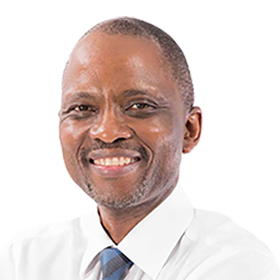
Mxolisi Mgojo
(60)
At Eyesizwe Coal, Mxolisi was responsible for marketing and logistics. After Exxaro’s formation, he managed the base metals and industrial minerals commodity business before he was appointed head of coal operations from August 2008. Mxolisi was appointed CEO designate on 1 May 2015 and CEO on 1 April 2016. He is a director of Tronox, Talent10 Holdings and Dynamo Investment Holdings. He was elected president of the Chamber of Mines (now Minerals Council) on 24 May 2017.

Riaan Koppeschaar
(50)
Riaan started his career with Coopers and Lybrand. After completing his articles, he branched into the fields of treasury, investment management and corporate finance. He held various senior management positions at Iscor, Kumba and Exxaro until his appointment as FD of Exxaro in 2016. He is a director of several Exxaro subsidiary companies and joint ventures. He is a trustee and investment committee member of the Exxaro pension and provident funds. Riaan is also a member of the Association of Corporate Treasurers of Southern Africa.

Geraldine
Fraser-Moleketi(60)
Geraldine was appointed special envoy on gender at the African Development Bank (AfDB) from 2013 to 2016. She served as director of the UN Development Programme Democratic Governance Group from 2009 to 2019. She also served as a member of the South African Parliament for three consecutive parliaments (1994 to 2008). She was Minister of Public Service and Administration for two consecutive terms (1999 to 2008). Geraldine served as Minister of Welfare and Population Development (1996 to 1999) after her term as Deputy Minister of Welfare and Population Development. During her tenure as Minister for Public Service, she was chairperson of the Pan African Ministers of Public Service for three consecutive terms. Geraldine serves on various boards across academia: she is the chancellor of Nelson Mandela University, chairperson of the Advisory Council of the Mapungubwe Institute for Strategic Reflection, chairperson of the Committee of Experts on Public Administration (an expert body of the United Nations Economic and Social Council) and former member of the Institute for the Study of International Development at McGill University in Canada. She served on the Africa Advisory Committee of Women’s World Banking until 2018. She is also a non-executive board member of the Standard Bank group and Standard Bank South Africa. She was recently appointed chairperson of the Tiger Brands group.
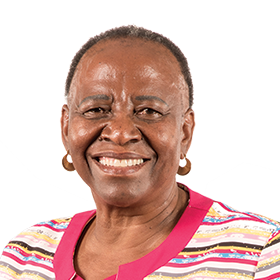
Likhapha Mbatha
(66)
Likhapha currently coaches National Movement of Rural Women coordinators in development methods and systems, project preparation, finance and management. She also supervises, monitors and evaluates small and medium development projects. She understands that poverty, inadequate education, nutrition, poor health, government policies and the exploitative nature of humans are uncontrollable variables that can lead to poverty. She focuses on development as an opportunity for affected individuals to lead equal and satisfactory lives within their communities despite their circumstances.
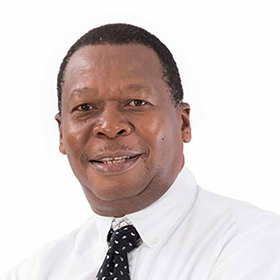
Zwelibanzi Mntambo
(63)
Zwelibanzi is executive chairperson of Moabi Capital. He was a senior lecturer at the University of KwaZulu-Natal, executive director of the Institute of Mine Surveyors of Southern Africa, director-general of Gauteng and chairperson of the Commission for Conciliation, Mediation and Arbitration. He is chairperson of Main Street 333, a director of Eyesizwe Holdings and Eyesizwe Mining, and a trustee of the Palaeo-Anthropology Scientific Trust.
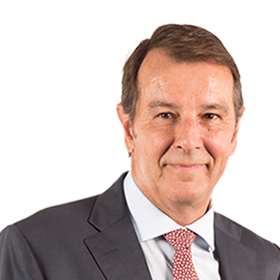
Mark Moffett
(61)
Mark has more than five years of public company board exposure and over 25 years of financial and commercial experience in the mining industry with leading global companies. He has worked in diamond, thermal coal, ferrochrome and platinum group metals mining. He understands the South African mining landscape and its strategic imperatives going forward. He has held senior financial positions (operational and corporate) in various countries with Anglo American, De Beers, Xstrata Alloys (as chief financial officer) and Xstrata (as group controller). He served as chairperson of Fraser Alexander until March 2018. Mark currently serves as an independent non-executive director and audit committee member on the board of Royal Bafokeng Platinum.

Isaac Mophatlane
(48)
Isaac is a co-founder, shareholder and director of the Randvest group with core focus on leveraged acquisitions and strategic investments mainly in technology companies. He is chairperson of Bothomed, which is currently a shareholder with the Public Investment Corporation in Dis-Chem Pharmacies. He is also a member of the Black Management Forum, the Electronics Industries Federation of South Africa, the Black IT Forum and non-executive deputy chairperson of the Catholic Education Investment Company.
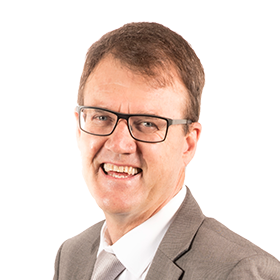
Ras Myburgh
(62)
From 1982 to 1996, Ras held various operational and executive positions in operating, maintenance, engineering and power station management at Eskom. In 1997, he joined Iscor Mining where he led company-wide cost improvement, business re-engineering, transformation and empowerment projects. He was appointed managing director of Kumba’s coal business in 2000 and headed the transformation unit in 2003 (project management of the empowerment transaction and unbundling of the company into Exxaro and Kumba Iron Ore). He was appointed as the first CEO of Kumba Iron Ore in 2006. Following the 2008 electricity crisis, Ras was seconded to Eskom to develop and implement a long-term coal supply strategy. In 2011, he co-founded Hindsight Financial and Commercial Solutions, a boutique corporate professional advisory firm, providing business development, specialist commercial solutions, and strategy and business improvement advisory services to the resources, energy and industrial sectors. He is a member of the Institute of Directors in South Africa and serves on the international advisory board of Unashamedly Ethical.
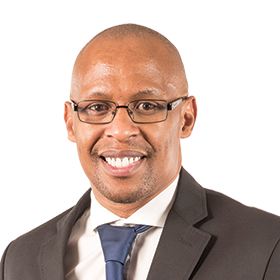
Vuyisa Nkonyeni
(51)
Vuyisa has over 20 years’ experience in investment banking and private equity. He served his training contract as a chartered accountant with PwC and joined Deutsche Bank in 1997 where he gained investment banking experience, primarily in corporate and project finance advisory work over four years. He serves on the boards of Emira Property Fund and Momentum Metropolitan Holdings. He served as financial director of Worldwide African Investment Holdings and a director of Actis in its BEE funding unit. He was appointed CEO of Kagiso Tiso Holdings in 2012 and resigned in December 2017.

Anuradha Sing
(49)
Anuradha is a non-executive director and member of the credit and investment, and audit and risk committees of the Development Bank of Southern Africa. She was a non-executive director of MTN South Sudan and MTN Guinea Bissau. She is currently group executive director of the MTN business intelligence competency centre.

Peet Snyders
(60)
Peet has 40 years’ experience in the mining industry, including employment at Sasol, Anglo American, Iscor, Kumba, Anglo American Platinum, Riversdale Holdings, Continental Coal, Keaton Energy, Sable Mining Africa, Mmakau Mining and, most recently, Submex Investments. He also has over 10 years of board experience within the industry
| Nomination committee chairperson | |
| Remuneration committee chairperson | |
| Social and ethics committee chairperson | |
| Audit committee chairperson | |
| Investment committee chairperson | |
| Sustainability, risk and compliance committee chairperson | |
| Executive directors |
| Audit committee member | |
| Investment committee member | |
| Remuneration and nomination committee member | |
| Social and ethics committee member | |
| Sustainability, risk and compliance committee member | |

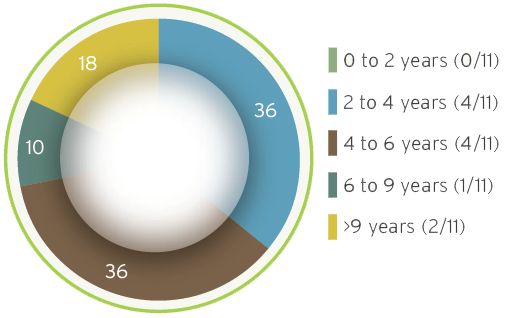


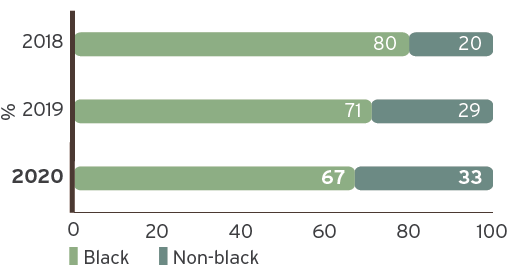
| * | Excluding Anuradha who retired by rotation on 28 May 2020. |
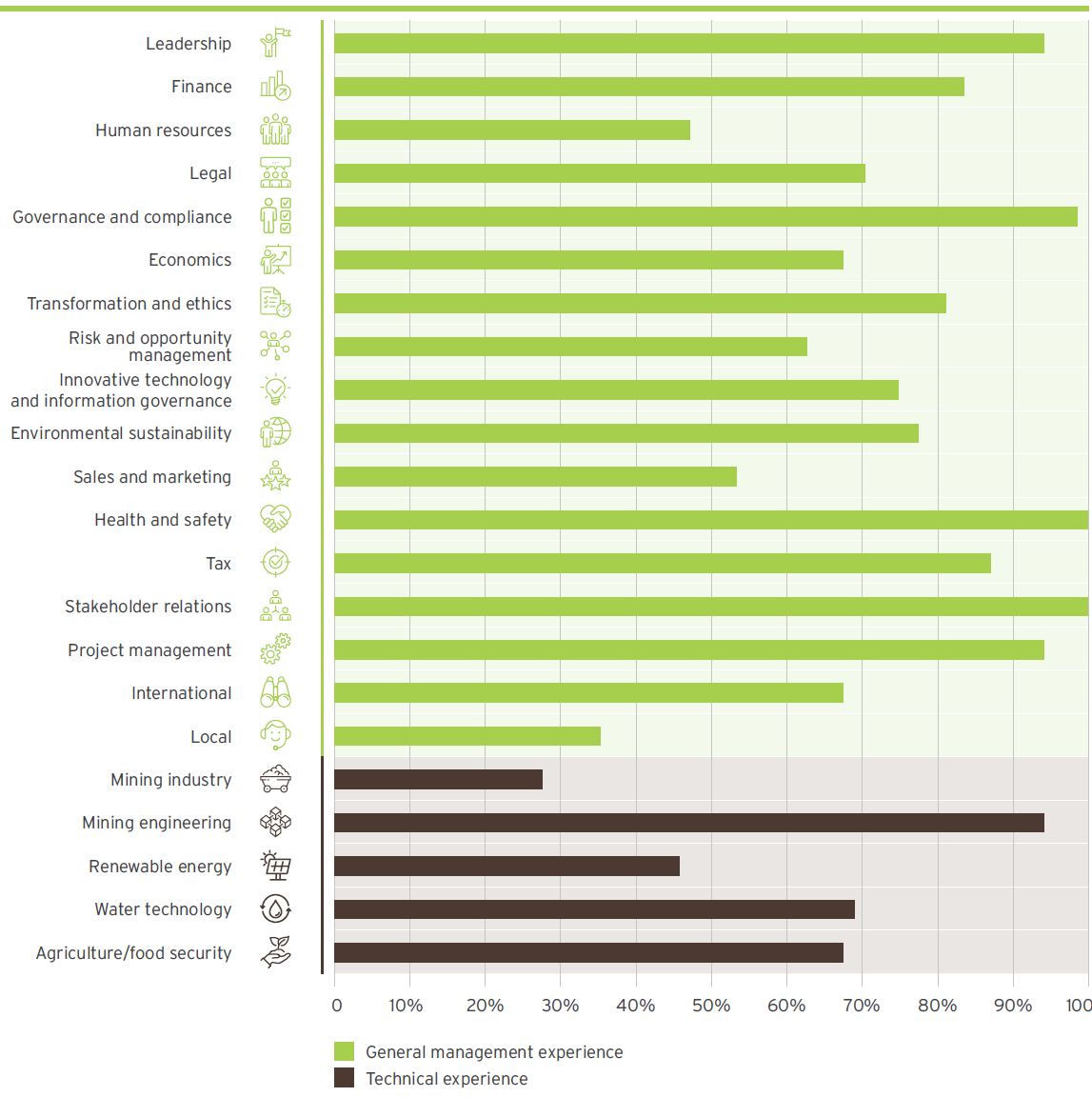
Refer to the ESG report for full details about the board and its roles and responsibilities.
Mxolisi Mgojo (60) 
At Eyesizwe Coal, Mxolisi was responsible for marketing and logistics. After Exxaro’s formation, he managed the base metals and industrial minerals commodity business before he was appointed head of coal operations from August 2008. Mxolisi was appointed CEO designate on 1 May 2015 and CEO on 1 April 2016. He is a director of Tronox, Talent10 Holdings and Dynamo Investment Holdings. He was elected president of the Chamber of Mines (now Minerals Council) on 24 May 2017.
Riaan Koppeschaar
(50)
Riaan started his career with Coopers and Lybrand. After completing his articles, he branched into the fields of treasury, investment management and corporate finance. He held various senior management positions at Iscor, Kumba and Exxaro until his appointment as FD of Exxaro in 2016. He is a director of several Exxaro subsidiary companies and joint ventures. He is a trustee and investment committee member of the Exxaro pension and provident funds. Riaan is also a member of the Association of Corporate Treasurers of Southern Africa.
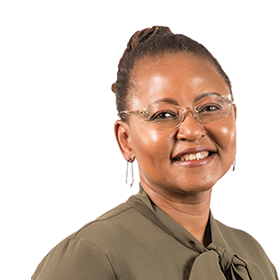
Nombasa Tsengwa (56)
Nombasa has more than 18 years’ executive management and board experience in the public and private sectors. In 2003, she joined Kumba as general manager: safety, health and environment. In 2007, she was appointed executive general manager: safety and sustainable development. In 2010, she became directly involved with the management of coal operations as general manager of captive mines and general manager of Mpumalanga operations. In 2015, she was appointed acting executive head of coal operations and executive head of coal operations in 2016. She is the 2017 winner of the Standard Bank Business Woman of the Year Award and the 2018 winner of the Pan African Awards Africa’s most influential woman in business and government mining industry category. An avid long-distance runner, Nombasa has completed nine Comrades marathons.

Vanisha Balgobind (47)
Vanisha is a registered industrial psychologist with more than 20 years’ experience in the mining industry. She joined Iscor Mining in 1997 as a human resources graduate trainee. She was later employed at Kumba as a human resources business partner and within talent management from 1998 to 2006. She has since been appointed by Exxaro as manager of the talent management and staffing centre of expertise, manager of corporate projects and human resources optimisation, and group manager of talent and learning. She is chairperson of Exxaro’s women in mining committee and serves on various other Exxaro subsidiary companies. She is passionate about education and women empowerment as well as integrating work and quality family time.

Alex De Angelis (40)
Alex has a mechanical engineering background with mining experience across a range of commodities. In his early career, he worked at several platinum and gold mines in South Africa and Australia. He moved into strategy consulting for 13 years, working on large-scale strategy, transformation and innovation projects in a range of companies. Alex joined Exxaro in 2018 and currently leads strategy and business transformation. He is passionate about innovation and learning, following new technology and leadership trends, keeping fit and spending time with his family.

Johan Meyer (52)
Johan started his career in production management at Iscor’s Pretoria steel works. He worked at KZN Sands, headed research and development at Kumba, as part of the leadership team at Mineral Sands (Tronox), BU manager of Zincor and Exxaro corporate office. His current role focuses on delivering coal growth projects of approximately R20 billion and developing integrated Mineral Resource and Mineral Reserve LoM plans. He is passionate about leading people and powering better lives in Africa and beyond.
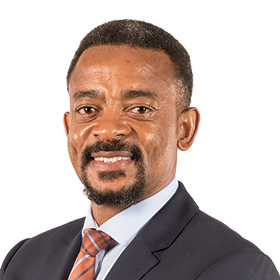
Mzila Mthenjane (50)
Mzila is a mining engineer with combined experience in mining and investment banking of 20 years. This includes seven years in deep-level gold mining at AngloGold Ashanti and Gold Fields in senior mine management and corporate development roles as well as six years in investment banking at Rand Merchant Bank and Deutsche Bank. His knowledge of business sustainability was honed over six years as executive: business sustainability at Royal Bafokeng Holdings and Royal Bafokeng Platinum. He assumed his current role in May 2013. Mzila also serves as the 2019/2020 president of the Southern African Institute of Mining and Metallurgy.

Wim Diedericks (53)
Wim started his career as an Iscor bursar from 1986 to 1990. He was engineer in training at Thabazimbi in 1992. He went on to Durnacol, Tshikondeni, Sishen, Rosh Pinah, Kumba head office and returned to Thabazimbi. Since Exxaro’s formation, he has held senior leadership positions at KZN Sands, Grootegeluk, Mpumalanga coal commercial region and corporate office. Wim was seconded to Exxaro’s divestment project team on a full-time basis in 2020.
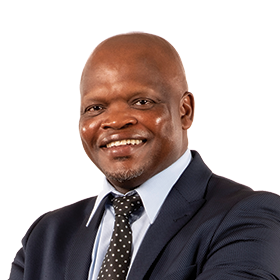
Mongezi Veti (57)
In the early 1980s, Mongezi worked for AngloGold at Western Deep Levels. He joined Sasol Mining in 1994. In 2002, he became mine manager at Arnot and was appointed general manager of Area 2 at Exxaro soon after the merger. In 2010, he was appointed general manager: safety, health, environment and community. In 2012, he was elected president of the South African Colliery Managers’ Association. Mongezi assumed his current role at Exxaro in 2015.

Saret van Loggerenberg (45)
Saret joined KPMG in 2002, advising clients on the legal aspects of information security, privacy and data protection. As senior manager of the regulatory and compliance services team, she advised clients on compliance programmes and reviews as part of internal and external audit. She joined Exxaro in 2008 as assistant company secretary and became manager: risk and compliance in 2012. Saret is a fellow of the Chartered Governance Institute of Southern Africa (formerly Chartered Secretaries Southern Africa) and a member of the International Institute of Risk and Safety Management.


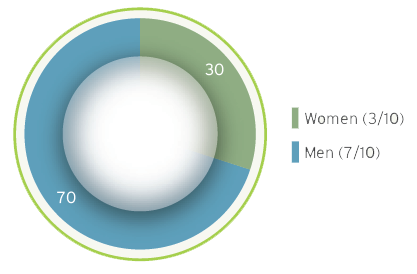

Refer to the ESG report for full details about the board and its roles and responsibilities.
The board of directors (the board) drives the strategy, sets performance and culture expectations as well as the governance framework for Exxaro, including its subsidiary companies, trusts and joint ventures.
In 2020, the board approved that the core businesses, energy and minerals, are empowered to exercise decision making and use their resources to thrive in an increasingly dynamic market and industry sector. The group is being designed to support this, with governance structures tailored to the level of maturity of core businesses, and to allow more decentralised decision making where empowered accountability can be exercised.
The board remains the focal point and custodian of corporate governance for the group and is fully committed to good corporate governance. The board regards good corporate governance as fundamentally important to create value, applying the following principles and governance outcomes in its own ethical and effective leadership:


See Governance of the ESG report for detailed disclosure.
At Exxaro, integrity is central to how board conducts itself and sets the tone for building a truly ethical culture that is the basis of how we conduct business.
Building organisational ethics is a journey. The board assumes responsibility for the governance of ethics and sets the direction for the approach to ethics and how it should be addressed by the organisation. Through the code of ethics, the company confirms the ethical principles of the organisation that, when followed, promote values such as trust, acceptable good behaviour and fairness.
Our values provide general guidelines for our interactions with each other and our stakeholders, and reflect what is important to us and how we conduct ourselves. Recognising that our public reputation is one of our most important assets, the organisation is committed to achieving the highest ethical standards in all our business operations. We recognise our obligations to all our stakeholders, particularly shareholders, clients, employees, business partners, competitors, the authorities, the environment and the wider community.
Our board charter and code of conduct (board charter) regulates the parameters in which the board operates, and ensures application of good corporate governance principles in all dealings by, in respect and on behalf of the company and the group. It sets out the roles and responsibilities of the board and individual directors, including the composition and relevant procedures.
For more information, refer to our ESG report.
For more information on our supplier code of conduct, please refer to https:// www.exxaro.com/assets/Files/8172_Exx_ SUPPLIER_SD_code_FA.pdf
The board ultimately considers and approves the short, medium and long-term strategy, as formulated and developed by management. During assessment and formulation of the strategy, the board engaged with executive and senior management in several strategy sessions throughout 2020. The board appreciates that the company’s core purpose, its risks and opportunities, strategy, business model, performance and sustainable development are inseparable elements of the value creation process. The insight that conditions are changing and there is a need to become future fit continues to drive decisions and measure transition going forward.
Our strategy is on Our strategy: Positioning Exxaro for sustainable growth and impact.

The board monitors the ethical culture of the group through its reporting structures, which include two board committees (the social and ethics committee, and the audit committee), and the ethics committee (a management committee).
Our internal auditors conducted an integrity survey in the group during 2020. Select employees participated in the survey and gave valuable feedback about the integrity culture, employees living the Exxaro values, employees’ adherence to these values and the code of ethics. Based on the survey results, the board made the following observations:
The survey results were positive overall and key areas identified that require focus and/or intervention are being addressed.

The board ensures the organisation’s strategy and conduct reflect in its drive to be a responsible corporate citizen and purpose to power better lives in Africa and beyond.
 The board adopted an emergency response plan in 2019, focusing on
capability interfaces for crisis management and business continuity, to
ensure integrated disaster or incident response and recovery. The plan
documents procedures that guide Exxaro’s response, recovery and
restoration of operations to a predefined level after disruption.
The board adopted an emergency response plan in 2019, focusing on
capability interfaces for crisis management and business continuity, to
ensure integrated disaster or incident response and recovery. The plan
documents procedures that guide Exxaro’s response, recovery and
restoration of operations to a predefined level after disruption.
When the South African government announced a national state of disaster and lockdown from 26 March 2020, the company immediately implemented its crisis management and business continuity plans across the group. The plans included health and safety controls and preventive measures implemented immediately and considered necessary to sustain our business. These plans also ensure we continue serving stakeholders, and protecting and supporting employees and their families.
For more information on Our response.
Exxaro’s corporate governance structure supports its ability to create value in the short, medium and long term. It is assessed to ensure agile decision making and to support business requirements. Through this structure, the board exercises effective control, and builds and protects the organisation’s reputation and legitimacy. We consider good corporate governance as the responsibility of our board, executive management and all our employees.
In accordance with our changing context, the remuneration and nomination committee, contributing to the governance enhancement programme, aims to align strategic changes in the group with board and board committee composition. This requires revision of committee terms of reference and review of its mandate.
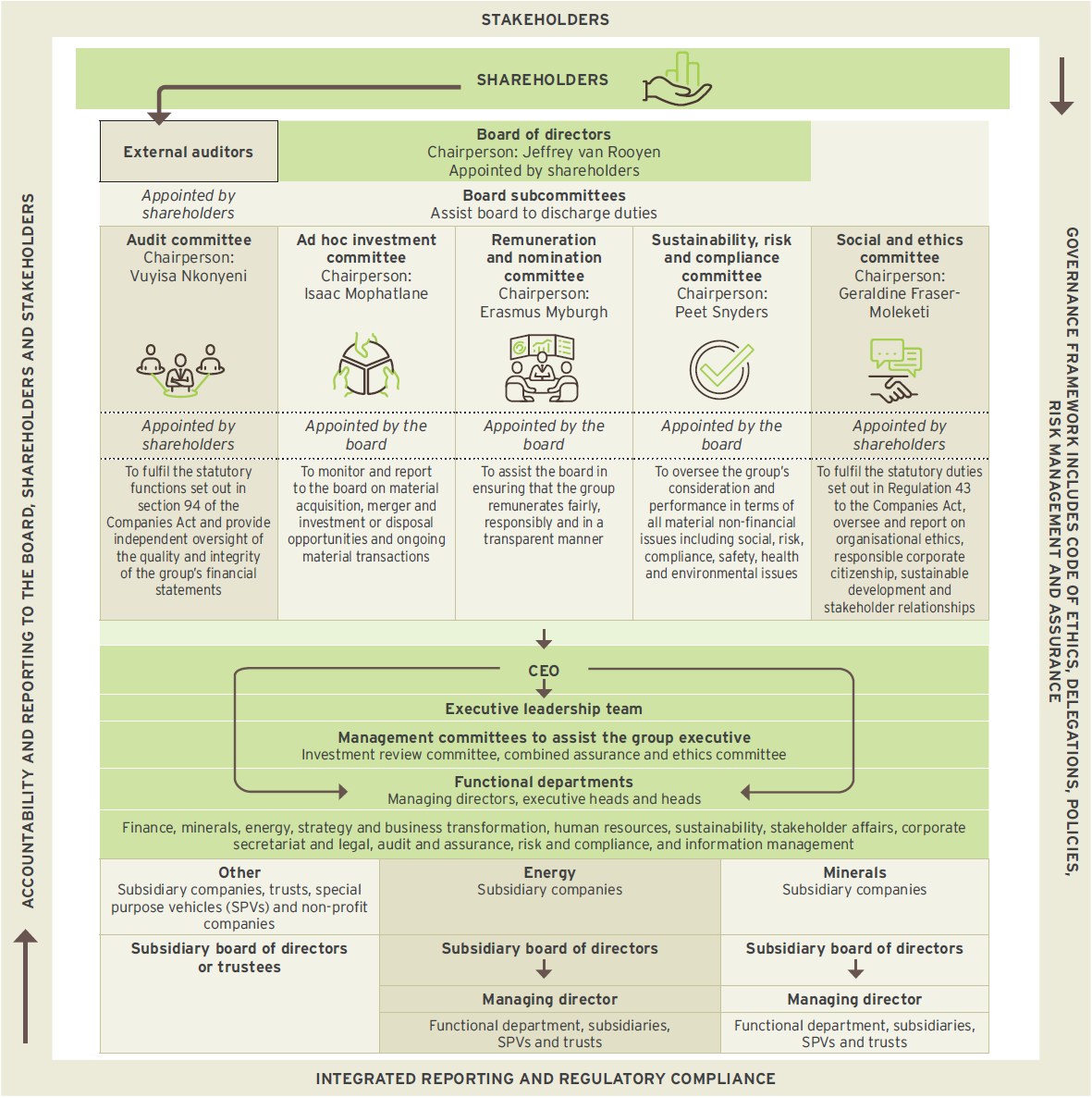
In the past year, Exxaro’s board committee structure embarked on a significant transformation journey, focusing on reimagining the operating model, acquisitions and evolving the broader business strategy. This is driven by a changing business environment and regulatory developments. To this end, Exxaro revisited and enhanced the respective terms of reference of its corporate governance structures. In line with King IV, considerations included:
The terms of reference of the respective committees were updated with key focus areas and objectives revisited. In addition, a reporting framework was developed addressing the board’s expectations about reports received from management.
Detailed reports from each of the board committee are on Remuneration and nomination committee report of the ESG report.
The board governs technology and information management in a way that supports the organisation setting and achieving its strategic objectives. As information management and governance form an integral part of overall enterprise governance, the board adopted the following policies:
The information management programme, including document information management and implementation of the data privacy programme in compliance with the Protection of Personal Information Act, 2013 (Act 4 of 2013) is in full force and effect.
Within our overarching values, we have five cultural themes: responsibility, adaptability, openness and connectivity, diversity and ownership. We aim to foster a culture of adaptability to the ever-changing world around us, encouraging employees to learn and improve in everything they do. As change is inevitable, based on current social, economic and technological realities, the company aims to be agile and create new opportunities to move the group forward as a collective.
This culture enabled the company to seamlessly continue business activities during the COVID-19 lockdown and deliver on its objectives.
We held our first virtual annual general meeting (AGM) in 2020, with shareholders or their proxies participating via electronic communication. Participants could vote during the AGM through an electronic participation platform. If participants wanted their vote(s) counted, they could submit information captured in the AGM notice to the platform service provider. Each shareholder who provided requested information was given a unique link to participate in the virtual meeting.
Our ERM approach provides a framework and process for all types of risk management, regardless of risk or impact type at all levels of the organisation. The same terminology and assessment mechanisms are used for finance, projects, safety and operational risk management. We have a set of risk names, one impact and one likelihood scale used across different disciplines to ensure management concentrates efforts and resources on material activities.
The board is satisfied that the company and group have a mature risk process that ensures risks potentially impacting its strategic objectives are pursued by management to create shareholder value.
Our top five risks in 2020 were:
Please refer to Business risks and opportunities for growth for details on our risks.
In support of its purpose to power better lives in Africa and beyond, 2020 saw the creation of the social impact strategy. The strategy ensures that the company continues to work towards improving the quality of our relationships with stakeholders. We strive to build long-term, stable and trusting relationships that create shared value. With a relatively procedural engagement approach, we mature through integrated and relational levels to the intentional, proactive management of stakeholder-related risks and opportunities.
More information on our Stakeholder engagements.
The board held four quarterly meetings, two governance sessions and seven special board meetings during the year. Attendance is calculated against the number of meetings the director was required to attend.
| Members | Designation | Attendance | ||
| Jeffrey van Rooyen | Independent non-executive director and board chairperson | 100% | ||
| Geraldine Fraser-Moleketi | Lead independent non-executive director | 100% | ||
| Riaan Koppeschaar | Executive director: finance director | 100% | ||
| Likhapha Mbatha | Non-executive director | 85% | ||
| Mxolisi Mgojo | Executive director: CEO | 100% | ||
| Zwelibanzi Mntambo | Non-executive director | 92% | ||
| Mark Moffett | Independent non-executive director | 92% | ||
| Isaac Mophatlane | Independent non-executive director | 100% | ||
| Ras Myburgh | Independent non-executive director | 100% | ||
| Vuyisa Nkonyeni | Independent non-executive director | 100% | ||
| Anuradha Sing# | Independent non-executive director (during her tenure) | 100% | ||
| Peet Snyders | Independent non-executive director | 100% |
| # | Anuradha retired by rotation on 28 May 2020. |
Phase 2 of implementation of the replacement BEE transaction: As part of the replacement BEE transaction of 2017, Exxaro committed to introducing appropriate schemes to benefit employees and communities. Exxaro is guided by the Mining Charter III when implementing these schemes.
An independent third party conducted a high-level evaluation of the board, committees and individual directors, including the chairperson and committee chairpersons, the finance director and the group company secretary. Board members participated in an independent evaluation process and received comprehensive feedback on the performance and effectiveness of the board and its committees. The purpose of the board evaluation was to ascertain:
The evaluation showed that, in the board’s opinion, its overall performance is satisfactory although definite areas warrant consideration and attention to further strengthen its performance and effectiveness. Specific observations and recommendations, based on ratings and comments, were made to the board and will form the basis of an action plan for 2021.
The board is satisfied that it complied with the provisions of the Companies Act and relevant laws of establishment relating to its incorporation, and that the company is operating in conformity with its MoI and other relevant constitutional documents. The board is also satisfied that it fulfilled its responsibilities in accordance with its charter during the reporting period.
Refer to our ESG report for the full corporate governance report.


