Integrated report 2020


Exxaro’s corporate governance structure supports its ability to create value in the short, medium and long term. It is assessed to ensure agile decision making and to support business requirements. Through this structure, the board exercises effective control, and builds and protects the organisation’s reputation and legitimacy. We consider good corporate governance as the responsibility of our board, executive management and all our employees.
We have the following board subcommittees:
In accordance with our changing context, the remuneration and nomination committee, contributing to the governance enhancement programme, aims to align strategic changes in the group with board and board committee composition. This requires revision of committee terms of reference and review of its mandate.
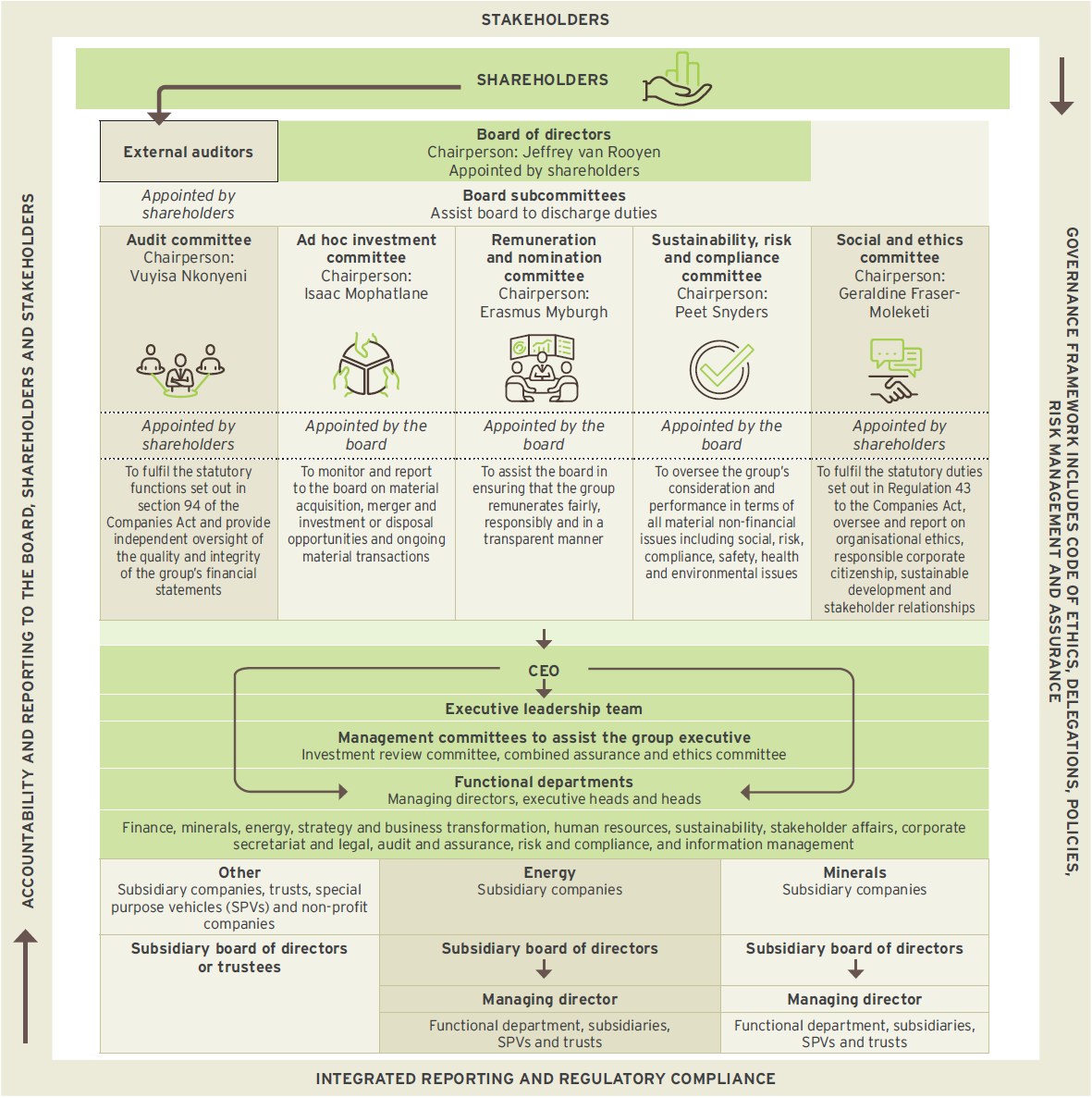
In the past year, Exxaro’s board committee structure embarked on a significant transformation journey, focusing on reimagining the operating model, acquisitions and evolving the broader business strategy. This is driven by a changing business environment and regulatory developments. To this end, Exxaro revisited and enhanced the respective terms of reference of its corporate governance structures. In line with King IV, considerations included:
The terms of reference of the respective committees were updated with key focus areas and objectives revisited. In addition, a reporting framework was developed addressing the board’s expectations about reports received from management.
Detailed reports from each of the board committee are on Remuneration and nomination committee report to Investment committee report.
The board retains full and effective control of the business and company’s affairs, and does not assume management’s functions, which remain the executive directors, prescribed officers and other senior management’s responsibility.
Exxaro is a separate legal entity with wholly owned subsidiaries and other subsidiary companies in which it has a percentage shareholding and joint ventures. These companies are connected and referred to as the Exxaro group of companies (or group).
The extract below from an Institute of Directors in South Africa practice note on a corporate governance framework provides background on the potential tension between Exxaro and its subsidiary companies.
“From a legal perspective, the board of directors of the subsidiary has authority to direct the affairs of the subsidiary. In a group context, this gives rise to tension between the interests of the shareholder (in many cases, a sole or majority shareholder of the subsidiary – also referred to as the holding company) and the duty of directors of the subsidiary (often appointed by the shareholder/holding company) to take decisions in the best interest of the subsidiary.
“In light of the above tension, it is not uncommon to find the following:
To mitigate possible tension between the holding company and its subsidiary boards, Exxaro implemented the following measures:
In practical terms, because the relevant subsidiary company is wholly owned, a shareholder vote is required in matters reserved for shareholder approval in terms of the relevant memorandum of incorporation (MoI). This means the board and/or its delegated committees have to cast a shareholder vote or consent rights.
However, because they are separate legal entities, subsidiary companies have to take a formal resolution on matters reserved for the subsidiary board, as set out in the Companies Act, MoI and relevant board charter. Directors on the subsidiary company's board have a fiduciary duty towards the subsidiary company and, as such, make decisions in the subsidiary company's best interests.
The delegation of authority policy defines the limits of authority designated to specific positions of responsibility in the company and group’s management structure. It also defines commitments and transactions that may include capital amounts that may be approved by individuals on Exxaro’s behalf. The final approval of commitments and transactions outlined in this policy must always be made by parties with designated authority.
Exxaro’s delegation of approval framework and delegation of authority policy are regularly reviewed to ensure aligned decision making. This also provides direction and clear delegation of power to management. The framework is adopted by our subsidiary company boards and implemented throughout the group as part of the overall group governance framework.
The purpose of the framework is to:
The board is satisfied that the delegation of authority framework contributes to role clarity and the effective exercise of authority and responsibilities.
The board governs technology and information management in a way that supports the organisation setting and achieving its strategic objectives. As information management and governance form an integral part of overall enterprise governance, the board adopted the following policies:
The information management programme, including document information management and implementation of the data privacy programme in compliance with the Protection of Personal Information Act, 2013 (Act 4 of 2013) is in full force and effect.

Within our overarching values, we have five cultural themes: responsibility, adaptability, openness and connectivity, diversity and ownership. We aim to foster a culture of adaptability to the ever-changing world around us, encouraging employees to learn and improve in everything they do. As change is inevitable, based on current social, economic and technological realities, the company aims to be agile and create new opportunities to move the group forward as a collective.
This culture enabled the company to seamlessly continue business activities during the COVID-19 lockdown and deliver on its objectives.
We held our first virtual AGM in 2020, with shareholders or their proxies participating via electronic communication. Participants could vote during the AGM through an electronic participation platform. If participants wanted their vote(s) counted, they could submit information captured in the AGM notice to the platform service provider. Each shareholder who provided requested information was given a unique link to participate in the virtual meeting.
Our enterprise risk management approach provides a framework and process for all types of risk management, regardless of risk or impact type at all levels of the organisation. The same terminology and assessment mechanisms are used for finance, projects, safety and operational risk management. We have a set of risk names, one impact and one likelihood scale used across different disciplines to ensure management concentrates efforts and resources on material activities.
The company linked all assurance activities and material issues to reduce assurance costs and derive greater value from auditing controls. Exxaro uses a tracking and monitoring system to afford transparency of audit findings to be closed out.
The risk management function, through the combined assurance model, coordinates with internal audit to obtain evidence on the effectiveness of treatment and control activities in achieving the desired and planned risk treatments. Assurance providers – internal audit, sustainability KPI audits, external assurance providers, self-assessments and accreditation
reviews – monitor effectiveness of significant risk treatments and compliance with regulatory requirements, non-binding rules, codes and standards, as well as policies and procedures.
The board is satisfied that the company and group have a mature risk process that ensures risks potentially impacting its strategic objectives are pursued by management to create shareholder value.
Our top five risks in 2020 were:
Please refer to Business risks and opportunities for growth of the integrated report for details on our risks.
The group is committed to maintaining high standards of integrity, professionalism and ethical behaviour in its relationships. While Exxaro complies with relevant legal requirements in its jurisdictions, the law serves as a minimum standard of conduct. Beyond complying with the law, it is important that every director and employee is sensitive to the appearance of improper conduct, and establishes whether or not our actions are honest and responsible.
The group's compliance philosophy is captured in a compliance policy. It supports ethical and responsible corporate citizenship, and seeks to create sustainable value for all stakeholders by striving for operational efficiency, growth and regulatory compliance with applicable laws.
The regulatory environment in which the group operates is regularly revisited to assess its robustness. It is refocused to ensure regulatory instruments are prioritised from a licence to operate perspective.
Electronic control self-assessments (CSAs) prioritise legislation included in the regulatory universe. These CSAs are high-level questionnaires providing a view of the level of compliance at functional and BUs levels. The results provide a base for the company's compliance assurance plan and intervention efforts that assist the functions and BUs to improve compliance.
Exxaro conducted an audit of its compliance function in 2020 to ensure effective compliance management was applied.
A strategic performance dashboard measures the company’s achievement of strategic objectives. It is a practical, value-adding tool that assists the company and board in understanding licence to operate requirements and forms part of the broader materiality concept and KPI development to measure compliance.
The status of the strategic performance dashboard is reported at each board and board committee meeting throughout the year.


