Integrated report 2020


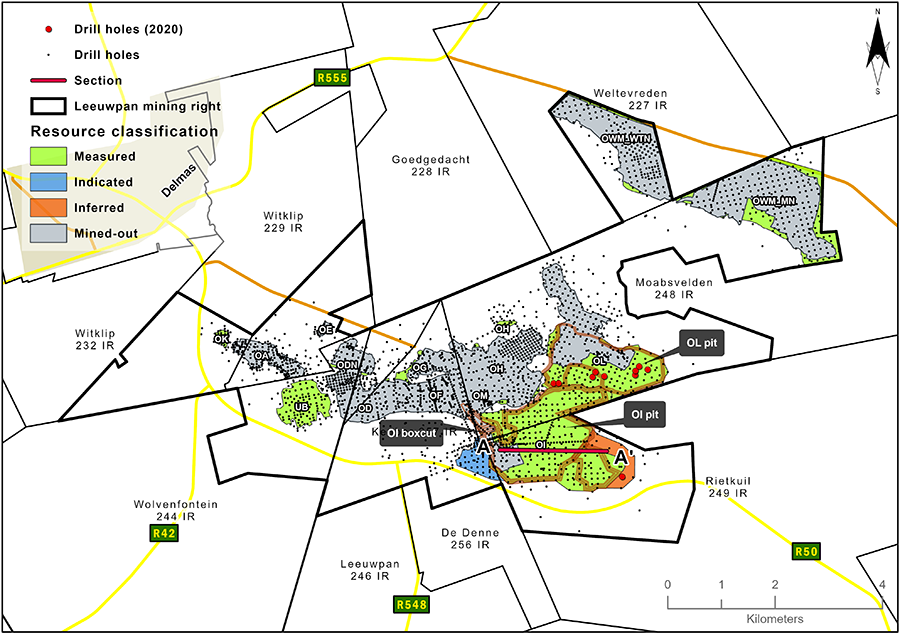
Leeuwpan mine is in the Delmas coalfield, on the western border of the Witbank coalfield. Leeuwpan, in the Victor Khanye Local Municipality in Mpumalanga province, is 10km south-east of the town of Delmas, 80km east of Johannesburg and 70km south-east of Pretoria. It lies alongside the R50 hard-topped secondary road and is serviced by a rail track that includes a rapid load-out station.
Leeuwpan is an opencast operation with various Reserves, in various pits, mined simultaneously. Current mining operations are on the OWM (depleted in March 2020), OL and OI Reserves. The mine uses trucks and shovels for mining-related operations. We estimate that the mine will be in production until 2028 with the mining right lapsing in 2039. Leeuwpan supplies domestic and export markets. The mine is equipped with a rapid rail load-out station, which is the preferred means of coal offtake, although road transport is accommodated.
Leeuwpan has two dense medium separator plants that beneficiate export thermal coal and two dry plants, crush-and-stack and bypass plants that handle selectively mined thermal coal either for the local market or the export market. The second dense media separation plant, commissioned in 2016, is operated by Fraser Alexander whereas the original plant is operated by Exxaro. Both plants are geared for 5 300kcal/kg production. The crush-and-stack and bypass can produce either 5 300kcal/kg, 4 800kcal/kg or 4 200kcal/kg products. All plants produce mainly thermal coal.
Leeuwpan has 3 321 boreholes in the mining right area covering 4 269ha but only 612 of those boreholes were used for the creation of the geological model. These boreholes were drilled in various drilling campaigns over the years. All Measured Resources at Leeuwpan are currently at 100m x 100m drill spacing.
Table 59: Leeuwpan operation history
| Date range | Company | Material notes | |||
| Up to 1988 | Southern Sphere | 262 borehole records exist for this period. Leeuwpan was sold to Kumba in 1988 | |||
|---|---|---|---|---|---|
| 1988 to 2006 | Kumba | Exploration began in 1990. Box-cut was commissioned in 1992. Rights were ceded to Exxaro Resources in 2006 | |||
| 2006 to 2019 | Exxaro Resources | Ongoing exploration campaigns focused mainly on operational derisking drilling programmes. This led to mining of additional pits of OG in 2007, ODN in 2010, OH in 2011, ODS in 2012 and OM in 2014. OWM was mined prior to 2011, stopped and reopened in 2011 and a similar occurrence in OJ where mining happened in two phases | |||
| 2020 | Exxaro Resources | Infill drilling occurred at OI and OL with 10 boreholes |
Figure 23: Leeuwpan coal mine
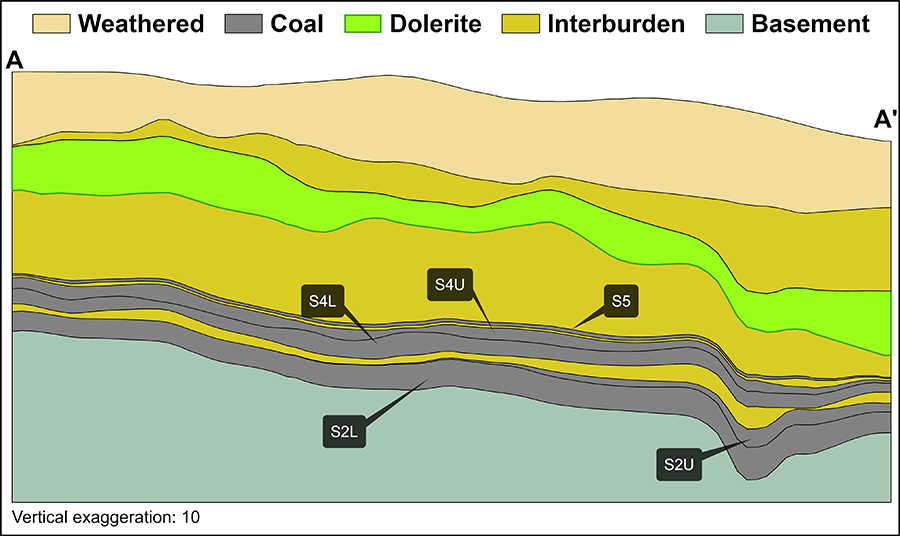
Two coal seams have been identified at Leeuwpan: top coal seam and bottom coal seam. The bottom coal seam correlates with the S2 of the Witbank and Highveld coalfields and the top coal seam correlates with the S4 and S5. The bottom coal seam qualities are generally higher than the top coal seam qualities.
The coal seams at Leeuwpan are primarily interbedded with sandstone, shale and carbonaceous shale. The coal was deposited on glacial sediments of Dwyka tillite, which in turn was deposited on dolomite of the Transvaal Supergroup. A significant amount of magma intruded as concordant sills of dolerite in the Karoo strata in the Delmas area. Associated with the dolerite intrusion are numerous thin dolerite dyke structures that transgress the stratigraphy. Factors controlling geological and quality continuity are mainly surface weathering, significant variation in seam thickness due to an undulating tillite floor, faulting associated dolerite activity and dolomitic basement, and devolatilisation and weathering due to dolerite intrusions (sills and dykes).
The average total seam thickness at Leeuwpan is 10.9m, with an average raw calorific value of 20.1MJ/kg, raw volatile matter of 18.7% and raw ash content of 31.4% (adb). These qualities require beneficiation for export-quality products.
Samples are named and numbered as per the standard task procedure at Leeuwpan (STP-LP-PO.003) which states that samples should be numbered on the borehole core using a wax marker in a different colour to that of the lithology code. The number of samples is recorded on the log sheet as per STP-LP-PO.002. Numbering of the sample tag is written in the order of Reserve BHID/sample number, example, MN971/2.
Samples are split on the lithological contact, if needed, using a chisel and hammer to ensure a clean break. Each sample is put in an individual bag with all contents represented in that interval, ensuring no contamination occurs between materials to be sampled. Should there be any unwanted material in the bag, a comment is made on the sample sheet. Two sample tags are written on plastic sample tags using a permanent marker. One sample tag is placed inside the bag and the second on the outside of the bag then sealed with a cable tie.
In 2019, SGS was awarded the coal quality analyses contract for sample preparation and analyses. Raw relative density is determined before the sample is crushed to -12.5mm and the 0.5mm fraction is screened out. Raw analysis is done on the +0.5mm -12.5mm material and float-sink analyses performed at float RD: 1.4, 1.5, 1.6, 1.7 and 1.8. Proximate analysis, CV and sulphur are performed on each fraction. All sample preparation is done in accordance with ISO 3909 parts 1 to 5.
SGS is SANAS-accredited for analytical work and participates in monthly local and international round robins.
Table 60: Leeuwpan Coal Resource reporting criteria
| Thickness cut-off (thickness and extraction height considerations) | Quality cut-offs (adb) | Geological loss* |
| <2m (2014 model) <1m (2015 model and onwards) <0.5m except S5 (2019 model) <1.0m for S5 (2019 model) |
Ash >50% | 5-100% (domains)* |
| * | A 5% standard geological loss is applied but may vary based on the consideration of structural complexity (dolerite sill breakthrough — 50% loss within determined spatial extent and fault displacement zone — 100%) and seam floor adulation (10% loss). |
Figure 24: Typical cross-section through Leeuwpan geological model (OI)
Geovia MinexTM is used to model the coal seams and estimate in situ Coal Resources at Leeuwpan. Coal Resource block sizes vary, and boundaries are determined by farm boundaries, coal qualities, coal thicknesses, infrastructure, environmental factors and geological structures. The model generates grid surfaces for the upper and lower boundaries of the coal seams from borehole intersection points. The grid surfaces of the top of a seam and bottom of the seam are then subtracted from each other to estimate the thickness of the seam. The washability qualities associated with each sample are also converted from point to grid data. The gridding of both structure and quality grids uses the same growth algorithm technique. The method gives smooth surfaces, which replicate the regional trends of geology, while reflecting local anomalies.
The Coal Resource classification methodology is fundamentally based on SANS 10320:2004 making use of borehole spacing but the type of boreholes and structural complexity of the Resource are also considered.
Table 61: Leeuwpan Coal Resource estimation criteria
Item |
Description | ||||
| Database | Borehole database | acQuire | |||
|---|---|---|---|---|---|
| Data datum | Cape LO29 | ||||
| Number of boreholes used for Resource estimation | 612 boreholes with 492 boreholes with wash analysis | ||||
| Validation | Conducted using queries in acQuire and Excel | ||||
| Data compositing and weighting | Geovia MinexTM | ||||
| Model | Previous model date | 2018 | |||
| Last model update | 2019 | ||||
| Geological modelling software | Geovia MinexTM | ||||
| Estimation technique | Growth algorithm | ||||
| Grid mesh size | 20m x 20m | ||||
| Scan distance | 1 000m | ||||
| Data boundary | 200m | ||||
| Model build limits | Upper: limit of weathering and topography/collar Lower: basement/Dwyka |
||||
| Model outputs | Roof, floor and thickness grids generated for structure Raw quality grids Wash quality grids |
||||
| Changes to modelling process | None |
Table 62: Leeuwpan Coal Resource classification criteria
| Category | Type of boreholes | Borehole spacing | Structurally complex areas | BH/ha | |||||
| Measured | Cored boreholes with applicable coal qualities | 0 to 100m | Resource blocks limited by faults, dolerite sill breakthrough and devolatilisation |
1.1 | |||||
|---|---|---|---|---|---|---|---|---|---|
| Geotechnical risks associated with faulting, dykes, sill and weathering – infill drilling | |||||||||
| Indicated | Cored boreholes with applicable coal qualities | 100m to 200m | Resource block limited by devolatilisation and coal depth – infill drilling | 0.6 | |||||
| Inferred | Cored boreholes with applicable coal qualities | 200m to 1 000m | Resource block limited by devolatilisation – infill drilling | 0.2 |
Table 63: Leeuwpan Coal Resource and Reserve statement
| Category | 2020 (Mt) |
2019 (Mt) |
Difference in tonnes (Mt) |
Difference (%) |
Reason for change | ||||||
| Measured | 79.9 | 92.8 | (12.9) | (14) | The net decrease is the result of mining (7.6Mt), a change in modelling methodology (3.9Mt), geotechnical disposals (1.5Mt) and model refinement (0.3Mt) offsetting the slight increase due to reconciliation (0.4Mt) | ||||||
| Indicated | 2.6 | 2.6 | – | 2 | |||||||
| Inferred | 3.6 | 3.6 | – | (1) | |||||||
| Total Coal Resources | 86.1 | 99.0 | (12.9) | (13) | |||||||
| Proved | 42.0 | 45.9 | (3.9) | (8) | The decrease is the result of mining depletion (6.22Mt) offsetting increases due to the mine plan and reconciliation (1.58Mt) | ||||||
| Probable | 5.7 | 6.1 | (0.4) | (6) | |||||||
| Total Coal Reserves | 47.8 | 52.1 | (4.3) | (8) |
Notes:
Table 64: Leeuwpan RPEEE considerations
|
|||||||||||||||||||||||||||||||||||||||||||||||||||||||||||||||||||||||||||||||||||||||||||||||||||||||||||||||||||||||||||||||||||||||||||||||||||||||||||||||||
The SANS 10320:2004 standard is used in the conversion from Coal Resources to Coal Reserves. The process typically progresses systematically through the stages of exploration, mine design, scheduling and costing. In each of these stages, modifying factors are applied to gain a higher confidence level for the purposes of reporting.
The Coal Resource is converted into a Coal Reserve through a process of applying modifying factors. The first of the modifying factors applied are usually the losses (both geological and mining), dilution factors, plant efficiencies/recoveries as well as quality considerations. Economic modifying factors will then be applied at a later stage to determine the economic viability of the reserve and estimate the cost of production and expected net present value (NPV) based on the selected mining method.
RoM Reserves are reported as Reserves within the LoM plan (LoMP), taking into account geological losses, dilution, mining losses, contamination and as-mined moisture corrections. All reporting is conducted on an air-dried basis.
Scheduling of the Reserve is determined using mine scheduling applications from OCCS, which is the same software used to develop the LoM plan schedule. Careful product selection and balancing of remaining reserves is required at Leeupan to ensure maximum value for Exxaro.
There is no difference between Resource grids and Reserve grids. Grid validation for Leeuwpan is conducted by checking for negative thicknesses, ensuring contact integrity and checking energy ratios to ensure progressive increase down the wash tables.
At Leeuwpan generally, the Measured Resources are converted to Proved Reserves, except for UB, where it is classified as a Probable Reserve because of additional modifying factors such as low volatiles and the limited market for this particular quality of coal. Indicated Resources are converted to Probable Reserves as is the case for OI West.
Table 65: Leeuwpan production figures
| Actual 2019 |
FC 2020 |
Actual 2020 |
FC 2021 |
FC 2022 |
||||||
| RoM (Mt) | 6.5 | 7.1 | 6.0 | 7.3 | 7.0 |
Table 66: Leeuwpan modifying factors considered in converting Coal Resources to Coal Reserves
| Modifying factors | Value | ||
| Geological loss | 5% to 100% based on risk domains | ||
| Average thickness cut-off | 0.5m all seams except S5 which is 1.0m | ||
| Quality cut-offs | N/A | ||
| Mining loss | 25% for S5 and 5% for all other seams | ||
| Boundary pillar | 100m | ||
| Dilution | 0 | ||
| Contamination | 5% on dense media separation plants and 1% on crush-and-stack plant | ||
| Mining recovery efficiency | 5% (crush-and-stack) and 5% (dense media separation bypass) | ||
| Planned average slope angles | 45 degrees. For highwall stability, soft material is mined at least one strip ahead of hard material and coal-mining activities | ||
| Practical plant yield | 90% dense media separation and 90% Frazer Alexander (FA) dense media separation with slimes loss on dense media separation of 9% and 15% on FA dense media separation | ||
| Strip ratio cut-off | N/A | ||
| Environmentally sensitive areas | Environmentally sensitive areas such as wetlands | ||
| Legal | Mining right boundary | ||
| Social | Socially sensitive areas in the mining right (such as graveyards) are excluded from Reserves in the reserving process | ||
| Geohydrological | Pit floor was taken into consideration to minimise water handling in the pit face |
Geological challenges (such as seam floor undulation and presence of sill and dykes) are addressed through proactive infill drilling, grade control and mine planning.
Groundwater management and pit dewatering requires constant monitoring to ensure that it does not influence production.
Achieving the higher than previously experienced overburden volumes, as scheduled, is critical to obtain the mine’s planned production.
The markets targeted by Leeuwpan are reviewed on a regular basis, as it is possible to produce to a number of qualities and uses. This needs to be monitored continuously with the ebb and flow of the market. The transition to the OI, which is substantially deeper than previous mining areas at Leeuwpan, has placed renewed importance on the cost of overburden removal and placement. Studies are underway to ensure that this is done in the best possible way. The use of a centralised control room, with in state-of-the-art in-time information of the full value chain plays a key role in this regard.