Integrated report 2020


Ras Myburgh
Remuneration committee chairperson
On behalf of the remuneration committee, I am pleased to present the remuneration report for the year ended 31 December 2020 for the Exxaro group of companies. I am satisfied that the committee continues its focus on the important work of aligning human resource and remuneration practices with the strategic priorities of the group.
As with our previous reports, the 2020 remuneration report includes background and context, including matters managed by the committee, as well as the group remuneration policy and implementation report with specific disclosure of the executive director's remuneration. Every year, we endeavour to ensure these reports comply with the requirements of King IV as well as best market practice.
The global COVID-19 pandemic forced most businesses to rethink and redefine practices at work. Likewise, at Exxaro during 2020 we spent a considerable amount of time reflecting on our business strategies and ensuring our people are empowered and aligned with our strategy in order to deliver our purpose to power better lives. We made some adjustments to our people management, talent development and remuneration and incentives to ensure our people will continue to thrive in the work environment brought about by the pandemic.
 The COVID-19 pandemic’s impact on business performance and remuneration and reward
The health and safety of our employees and communities remained top of mind as South Africa implemented lockdown regulations in 2020. Exxaro's response focused on minimising people impacts first and second production and business impacts in such a way to live up to our values of caring.
Although the early stages of the lockdown resulted in loss of production, the business responded with great resilience and overall the operational and financial results were better than the corresponding period in 2019 as reported elsewhere in this report. The result was that employees only qualified for tier 1 of the STI scheme. There was also a negative impact on the vesting conditions of the LTIP as the total shareholder return (TSR) performance condition was not met.
We are particularly pleased to report a record safety performance during 2020. Exxaro achieved 48 months without a mine-related fatality and a LTIFR of 0.05, which is 55% better than the 0.11 target. This excellent performance contributed to incentive awards including a payment of R2 500 as a fatality-free recognition payment.
Business sustainability
As mentioned, the wellbeing of our employees was elevated by the pandemic and we took extraordinary measures to protect our workforce in unprecedented working conditions. The most important of these can be summarised as follows:
Remuneration actions
Specific remuneration-related actions necessitated by the pandemic included:
The 2019 remuneration policy and accompanying implementation report were tabled in two separate resolutions for non-binding advisory votes by shareholders at the 2020 AGM. We were pleased with the upward turn in Exxaro's voting record at this AGM.
We believe that the improvement was due to improved shareholder engagement as well as changes to the remuneration policy and reporting approach following inputs received during the engagements. The phased implementation of the changes are on track. During the year, the performance conditions of the LTIP were reviewed and implemented. A policy on minimum shareholding was also developed and adopted by the board for implementation by the next cycle. The targets of the SPR was split into 50% achievement of business targets and 50% achievement of individual targets as part of a transition process to change the current STI and SPR into a single STI for implementation during 2021. Shareholders will be asked to vote in favour of the introduction of the malus and clawback clauses for the LTIP scheme in the forthcoming AGM.
The committee plans to continue engagement with shareholders in terms of a two-year cycle or as required if either the remuneration policy or implementation report are voted against by 25% or more of voting rights exercised.
| Shareholder vote | 2019 | 2018 | 2017 |
| Approval of the remuneration policy | 95.37% | 73.09% | 82.90% |
| Approval of the implementation of the remuneration policy | 95.53% | 76.38% | 83.30% |
Exxaro achieved top employer accreditation from the Top Employers Institute acknowledging our human resources policies and practices.
Fair pay
Aligned with the principles of the UNGC, our diversity and inclusion initiatives continue to focus on gender equality and women empowerment in partnership with UN Women as well as our connect2NEXT journey towards people empowerment.
Our diversity and inclusion strategy includes the principle of fair pay. We conducted detailed analysis to understand the extent of pay disparity in our management and specialist employee categories, as well as the circumstances and contexts of these disparities.
Performance management
A revision of the performance management system introduced changes to the group performance achievement framework to strengthen our aspirational culture transition and improve the alignment of personal objectives to achieve business excellence.
Learning and development
The COVID-19 pandemic negatively impacted the roll-out of learning interventions and the achievement of SLP commitments, including recruitment of new learners and interns. To mitigate these risks, Exxaro implemented online meeting platforms during lockdown and Exxaro's MyNexxt cloud-based learning management system was complemented by piloting Powering Knowledge, a business skills development initiative for communities at Belfast and Grootegeluk.
ESOP (Greenshare)
We implemented a new ESOP, the Greenshare scheme, for participating employees in Paterson D lower and below grades in 2020.
Independent remuneration advisers
We continue to seek independent and professional advice regarding remuneration matters from consultants regarded by the committee as fully independent. Exxaro received the following advice during the review period:
Some remuneration policy changes are contemplated for 2021 as we continue to align our remuneration policy to enable implementation of our future business strategy. Our remuneration policy will evolve as we embed applicable best-fit market practices.

In addition to the normal work plan, the committee will focus on the following areas in 2021:
Up to 2020, NED annual fees were predominantly based on comparable benchmarks and paid as a monthly retainer. From 2021 onwards, the committee introduced a revision to the process based on an estimated annual required working hours and an hourly rate in addition to industry benchmarks for each of the activities of the board and its committees. The committee believes this approach enables more internal parity between different committees of the board. Annual fees will still be paid in equal monthly retainers and a special fee for ad hoc meetings. The structure and remuneration of all subsidiary boards and their committees will be aligned with the new approach for the main board.
The minimum shareholding requirements (MSR) policy for executives and prescribed officers will come into effect in 2021 and the malus and clawback provisions will be integrated into the company practices when changes to the LTIP scheme and DBP rules are approved by shareholders at the AGM.
At the AGM in May 2021, shareholders will be asked to endorse our remuneration policy and its implementation. Be assured that we value and appreciate your constructive inputs as we continue to strive for excellence also in this important aspect of our business.
I thank my fellow committee members for their support and wise counsel during the review period. I also thank the executive head of human resources and her team for their hard work and dedication in ensuring Exxaro remains competitive in the market and a sought after top employer.
EJ Myburgh
Remuneration committee chairperson
19 April 2021
In this section, we provide a broad overview of the remuneration philosophy, principles and policies applicable to the various remuneration elements in terms of various employee categories including executive directors, prescribed officers, senior management and other employees.
Notwithstanding high levels of support from previous shareholder engagements, an internal review of our remuneration policy resulted in changes recommended to the remuneration committee. We share a summary of these changes to the remuneration policy.
Our remuneration philosophy underpins our strategy and enables us to achieve our business objectives. Our commitment to pay for performance in alignment with shareholder value creation drives all our remuneration activities and continues to deliver a sound value proposition to employees.
We strive to attract, retain and empower the best talent to achieve our strategy and create sustainable shareholder value.
Our vision for rewards is to provide simple, integrated, holistic solutions, common messages and transparency, and a package differentiated from the market for us to attract, retain and energise talented, high-performing people as our employee offering.
We understand that remuneration is critical in attracting and retaining high-performing individuals. As such, the committee firmly supports the principle that pay must be aimed at reinforcing, encouraging and promoting superior performance. We believe in ethical, fair and responsible remuneration principles, and this belief which continues to guide our policies directed at different remuneration elements in our remuneration framework.
The overarching
guiding principles on remuneration
The table below shows the remuneration offering used to reward employee categories in a fair and equitable manner. The policy provides for an annual assessment of the wage gap and consideration of any appropriate actions such as differentiating annual adjustments. In addition, the principles of internal parity, reward for performance and market competitiveness apply. These principles facilitate fair and responsible remuneration.
| Employee category* | Total guaranteed remuneration |
Variable pay | |||||
| STI schemes | LTI schemes | ||||||
| Notional cost of employment (NCOE) |
Total guaranteed package (TGP) |
STI | SPR | LTIP | DBP** | ESOP | |
| Executive management (F band) |
x | x | x | x | x | ||
| Senior management (E band) |
x | x | x | x | x | ||
| Middle management (D upper and middle bands) |
x | x | x | x | |||
| Junior management (D lower and C upper bands) | x | x | x | ||||
| Non-management and specialist employees at corporate office (C middle to A bands) |
x | x | x | ||||
| Bargaining unit employees (C middle to A bands) |
x | x | x | ||||
| * | The Paterson job grades are indicated by applicable employee category. |
| ** | DBP excludes Paterson E lower grade. |
The following changes to the variable pay schemes were introduced during 2020. This was a result of shareholder engagements in 2019, when we were able to make some changes to the variable pay schemes for the current cycle. Applicable changes will impact the performance-based reward outcomes for the executive directors and prescribed officers. The table below summarises the impact on applicable elements:
| Element of remuneration | 2020 change |
2021 change
Implementation of the first phase of the revised STI is planned during 2021. Current STI and SPR will be applicable until implementation of new STI.
|
|
| STI and SPR | The SPR objectives were split between 50% individual and 50% business objectives for 2020
A process was started to design a new STI that will replace the current STI and SPR
|
||
|---|---|---|---|
| LTIP |
ROCE replaces headline earnings per share (HEPS) as performance condition with the weight remaining as 33.33%. Revised performance vesting conditions at threshold and maximum introduced
|
||
| MSR | The committee has approved a minimum shareholding requirement policy during 2020 whereby certain employees will be required to hold a specified number of shares in Exxaro for a period of five years from the date of the implementation of the policy or from date of appointment or promotion. The policy was approved in 2020 for implementation in 2021.
|
Implementation of policy. |
|
| Malus and clawback | Malus and clawback provisions have been introduced Exxaro's remuneration policy. Malus will be applicable to all STI, SPR, DBP and LTIP awards before vesting or settlement date and clawback will apply to all STI, SPR, DBP and LTIP awards for 36 months after vesting or settlement date. |
The policy is still to be approved at the AGM 2021 for implementation in 2021. |
Remuneration mix
The table below indicates the maximum percentage of total guaranteed remuneration (NCOE/TGP) applicable to the variable pay schemes by grade. The remuneration mix is benchmarked on an annual basis prior to the granting of annual LTI awards.
| Grade | Maximum STI (%) |
Maximum SPR (%) |
Maximum STI schemes (%) |
Maximum LTIP (%) |
Maximum DBP* (%) |
Maximum LTI schemes (%) |
Maximum total variable pay (%) |
| F upper* | 18.33 | 37.00 | 55.33 | 231.00 | 27.39 | 258.39 | 313.72 |
| F lower* | 18.33 | 32.00 | 50.33 | 143.00 | 24.91 | 167.91 | 218.24 |
| E upper* | 18.33 | 25.00 | 43.33 | 101.00 | 21.45 | 122.45 | 165.78 |
| E middle | 18.33 | 20.00 | 38.33 | 76.00 | 10.54 | 86.54 | 124.87 |
| E lower and D upper | 18.33 | 15.00 | 33.33 | 50.00 | 0.00 | 50.00 | 83.33 |
| D middle | 18.33 | 10.00 | 28.33 | 38.00 | 0.00 | 38.00 | 66.33 |
| D lower and below | 18.33 | 0.00 | 18.33 | 0.00 | 0.00 | 0.00 | 18.33 |
| * | The maximum DBP matched portion is 90% of the total after-tax STI schemes for F band and E upper Paterson grades and 50% for E middle Paterson grade. |
The table below provides an indication of the total variable pay due, by component, for achievement at target. The STI and SPR schemes explicitly state the target bonus quanta applicable at target. The LTIP performance vesting conditions are defined at maximum and threshold. To provide an indication of targeted total variable pay, target is considered halfway between threshold and maximum. In the case of the DBP, we applied the midpoint of the voluntary deferral, 50% to the target STI schemes.
| Grade | Target STI (%) |
Target SPR (%) |
Target STI schemes (%) |
Target LTIP (%) |
Target DBP* (%) |
Target LTI schemes (%) |
Target total variable pay (%) |
| F upper* | 8.33 | 33.30 | 41.63 | 150.15 | 11.45 | 161.60 | 203.23 |
| F lower* | 8.33 | 28.80 | 37.13 | 92.95 | 10.21 | 103.16 | 140.29 |
| E upper* | 8.33 | 22.50 | 30.83 | 65.65 | 8.48 | 74.13 | 104.96 |
| E middle | 8.33 | 18.00 | 26.33 | 49.40 | 7.24 | 56.64 | 82.97 |
| E lower and D upper | 8.33 | 13.50 | 21.83 | 24.70 | 0.00 | 24.70 | 46.53 |
| D middle | 8.33 | 9.00 | 17.33 | 24.70 | 0.00 | 24.70 | 42.03 |
| D lower and below | 8.33 | 0.00 | 8.33 | 0.00 | 0.00 | 0.00 | 8.33 |
| * | The target DBP matched portion is 50% of the total after-tax STI schemes for F band and E upper Paterson grades and 50% for E middle Paterson grade. |
Remuneration mix for CEO, FD and prescribed officers
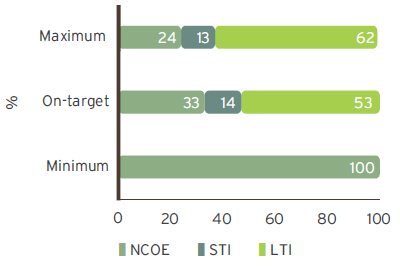
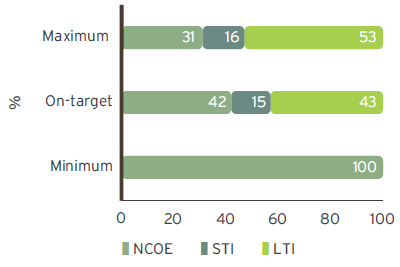
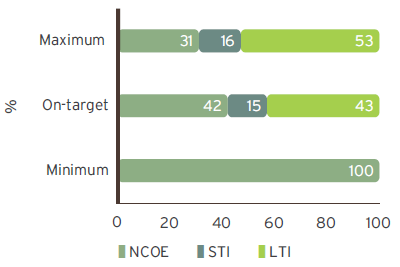
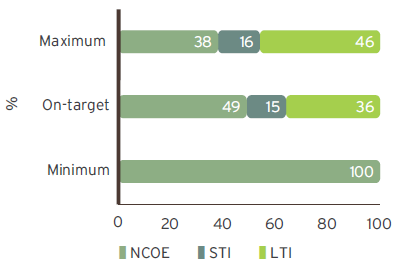
Total guaranteed remuneration
Our policy at Exxaro is to:
NCOE
NCOE is the guaranteed remuneration portion of total pay and includes basic salary, benefits and retirement funding.
Basic salary
All bargaining unit employees receive a market-related basic salary complemented by guaranteed allowances (housing and commuting), variable allowances (shift and standby) as well as benefits (see full list of benefits below). Bargaining unit employees have received increases of between 0.5% and 1.5% higher than management and specialist category employees per annum over the past 14 years (2006 to 2019), to reduce the wage gap.
The committee unanimously agreed that, given the potential impact of the Covid-19 pandemic and a drop in export market demand, which is a significant revenue contributor to Exxaro's revenue stream, no salary adjustment in 2020 for the executive, management and specialist category of employees as well as NEDs would be implemented. Bargaining unit and non-management and specialists at corporate centre received an average increase of 5.5%.
Benefits
All employees are entitled to the same range of benefits appropriate to their role level and specific circumstances. Management and specialist employees have flexibility in structuring their remuneration within certain company and legislative limitations. During the year, no changes were made to the policies for medical, health and other benefits stated below. The only change was to the retirement funds.


All employees are members of one of Exxaro's accredited retirement funds. Retirement fund contributions are determined by specific conditions of employment and for the different levels and categories of employees.
Iscor Employees Umbrella Provident Fund was removed as an accredited retirement fund with effect from 31 December 2020. All members moved to one of the other accredited retirement funds.
Employees may annually elect to belong to any of the accredited medical schemes as they apply to the relevant employees. Contributions are made by employer and employee. Exxaro does not provide any post-retirement medical benefits. The post-retirement benefit obligation disclosed in the annual financial statements recognises past practice (by Eyesizwe) that was discontinued with the creation of Exxaro in November 2006.
Employees are beneficiaries of a policy that provides additional cover for death, disability and dread disease through group personal cover taken out by Exxaro.
Company provided services to support employees, emotions, personal, legal, financial, family and subsistence.
The STI schemes focus on annually contributing to the strategic goals and delivering on Exxaro's operational and financial objectives in the shorter term.
Exxaro has two STI schemes:
The SPR scheme applies to all permanent employees (Paterson grade D middle and above) in Exxaro's management and specialist category.
Participants in the scheme are required to have an SPR contract with individual SPR objectives for the 12-month period. It is evaluated twice a year and the final rating forms the basis for payment of the SPR scheme.
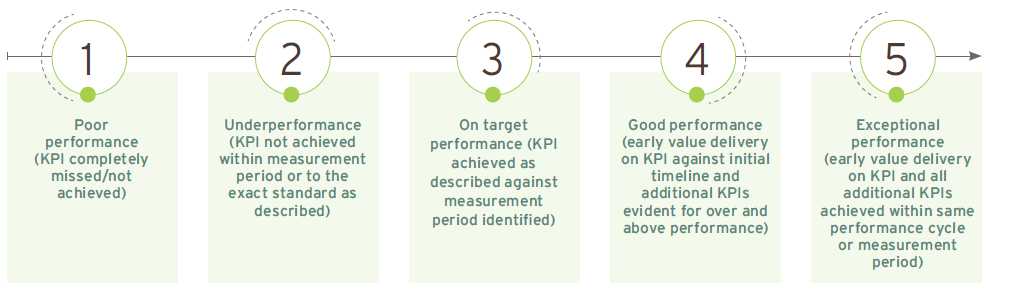
The SPR is measured on an annual basis and paid out in March of the following year. Once the SPR target has been achieved (three rating on a five-point rating scale), a potential of 90% will be paid out. Above-target achievement (four rating on a five-point scale) will qualify for a maximum of 100% pay out. If target was not achieved (two or below on a five-point rating scale), there will be no pay out applicable to the employee.
The STI scheme applies to the Exxaro group and is based on business performance with two components:
The STI is measured six-monthly for Tier 1 (January to June and July to December). It is paid out in August and February. A BU will qualify for Tier 1 on a sliding scale between a threshold of 90% and 100% performance against targets. When the modifier kicks in, if 90% of target is achieved, no payout is applicable. If 95% of target is achieved, 4.165% of the potential 8.33% payout will be applicable. If 100% of target is achieved, 8.33% (of annual guaranteed remuneration) will be payable.
Tier 2 is measured on an annual basis from January to December and paid out in February. To qualify for Tier 2 an improvement in group net operating profit between 101% and 131.4% above target is required for 2020 and a sliding scale is applied. If 131.4% improvement is achieved a maximum of 10% (of annual guaranteed remuneration) will be payable.
If a BU, coal commodity business or corporate achieved between 91% - 100% of Tier 1 they will only share in the same proportion in Tier 2. For example, maximum of Tier 2 is achieved (10% of annual remuneration will be paid) but a BU only achieved 95% of Tier 1, then only 50% of Tier 2 will be paid (5% of annual remuneration for Tier 2) to that BU.
| STI component |
Percentage of total guaranteed remuneration (%) |
Description of measures |
Threshold (0% of STI) |
Maximum (100% of STI) |
| 1 | 8.33 |
BU BU net operating profit versus target Coal commodity business Average of business units Corporate centre Consolidated group core net operating profit target |
90 | 100 |
| 2 | 10.00 | Exxaro group Group net operating profit above target |
101 | 131.4 |
Tier 1 target for Ferroland is their operating expenditure target. Tier 1 target for Coastal Coal (Durnacol/Hlobane and Tshikondeni) is based on objectives set out in a scorecard based on the mines in closure and rehabilitation plans.
Tier 2 target for these BUs is the improvement above target of 101% to 131.3% in group net operating profit. Should 100% of the Tier 1 target be achieved, they share in the Tier 2 incentive on the same percentage ratio achieved in Tier 1.
Junior management and bargaining unit employees at commercial and tied operations, who are directly involved in production, qualify for line-of-sight STIs. The schemes are based on coal production with modifiers for safety and attendance per mining section. Both these schemes work on a sliding scale with threshold and full performance targets. Participants in these schemes do not qualify for the standard STI schemes.
Our LTIs consist of two schemes, which align remuneration with longer-term shareholder expectations and outcomes. Exxaro makes general share offers to participants (Paterson D middle and above) once a year in terms of the LTIP scheme and the DBP plan.
Greenshare, our new ESOP, was introduced in July 2020 and is applicable to employees not participating in the LTIP scheme and DBP plan.
The remuneration committee makes annual conditional performance awards which are subject to the achievement of performance targets and employees remaining in employment for three years to qualifying employees from executive management, senior management and middle management.
The face value of the allocations depends on the employee's NCOE and a grade-specific percentage, and the percentage of awards that ultimately vests ranges between a median threshold (50%) and a maximum (100%), depending on the level of performance relative to performance targets. Proportional vesting is calculated for an actual performance result between threshold and maximum. A linear sliding scale is used between the threshold and maximum. For any actual performance below threshold, no awards will vest and for any performance at or exceeding the maximum, the awards that will vest are capped at 100%.
Awards vest after three years, subject to fulfilling the performance conditions.
In the award, 33.33% will be based on ROCE.
The ROCE calculation will be based on net operating profit plus income from non-equity-accounted investments plus income from equity-accounted investments, as a percentage of average capital employed.
Therefore, a sliding scale based on a percentage ROCE achievement will apply as follows:
The ROCE will be calculated as the arithmetic average of the three years constituting the performance period.
Relative TSR has a weighting of 33.33% and will be compared to performance against the TSR peer group, namely the companies listed on the FTSE/JSE Resources 10 index as at the preceding December of the offer.
The peer group listed companies included in the FTSE/JSE Resources 10 index as at December 2020 were Anglo American Platinum, Anglo American, Northam Platinum, BHP Billiton, Impala Platinum, Sibanye-Stillwater, Sasol, AngloGold Ashanti, Harmony and Gold Fields.
Exxaro's TSR, for the purposes of this plan, is defined as the compound annual growth rate (CAGR) on a portfolio of Exxaro's ordinary shares purchased in December preceding the grant, holding the shares and reinvesting the dividends received from the portfolio in Exxaro shares until the end of the performance period, and then selling the portfolio on that day.
The monthly TSR calculation will be performed using the dividend payments and Reuters share price data on the nearest trading day to 31 December preceding the award and the nearest trading day to 31 December at the end of the performance period, and computing the CAGR between these values.
The TSR will be smoothed by computing the TSR in the same manner for the three-year period following each trading month for the six months preceding 31 December of the award, which means that the TSR is computed from:
The TSRs computed in this manner will then be arithmetically averaged to yield the final "smoothed TSR" for the TSR performance condition.
The smoothed TSR for each member of the peer group will be computed over the same period in the same manner. This period of smoothing is in line with the market.
If the TSR of Exxaro over the three-year period is equal to the minimum TSR target, the minimum LTIP award (50% of the TSR portion of the grant) vests.
If the Exxaro TSR is equal to or greater than the maximum TSR target, then 100% of the grant will vest.
The award vests linearly between 50% and 100% for performance between the minimum TSR target and the maximum TSR target.
The TSR targets for the LTIP grant are:
The remuneration committee has the discretion to make adjustments to the method of computation of the TSR for the peer group and for Exxaro. Under the rules of the plan, the remuneration committee may vary the TSR condition if events occur that would make such a variation necessary or desirable or would make the amended performance condition a fairer measure of performance.
ESG targets have a weighting of 33.34%. The targets will be measured in terms of the approved strategic dashboard used to monitor achievement of the business strategy:
The table below summarises the performance vesting conditions applicable to the 2020 awards.
| Performance vesting condition | Weight (%) | Vesting of awards (after year three) |
| ROCE | 33.33 | 17% ROCE achievement will result in 50% vesting (threshold) |
| 19% ROCE achievement will result in 90% vesting (target) | ||
| 22% ROCE achievement will result in 100% vesting (stretched) | ||
| TSR | 33.33 | Median TSR peer group position will result in 50% vesting |
| Top three TSR peer group position will result in 100% vesting | ||
| ESG as per FTSE Russell index | 33.34 | Median ranking will result in 50% vesting |
| Upper quartile ranking will result in 100% vesting |
Where the actual performance falls between the stated ranges, linear interpolation will be applied between the stated vesting points.
The rules and calculating principles will follow the same approach as set out in detail for the 2020 LTIP above.
The remuneration committee selects participants, based on employee grouping and performance, from executive management and senior management to participate in the DBP. The scheme encourages share ownership while reinforcing retention.
Participants from F upper to E upper Paterson grades can elect to voluntarily use a portion (0, 50% or 90%) and E middle (50%) of their after-tax STI payments to acquire Exxaro shares at the prevailing market price.
Participants are entitled to all rights in respect of the shares (pledged) purchased with their after-tax STI, including dividends. If the pledged shares are held for the three-year pledged period, and participants remain in the employ of Exxaro for this period, Exxaro will provide a matching award on a one-for-one basis.
No performance vesting conditions are applicable to the matching award.
Our new ESOP scheme, Greenshare, was implemented in 2020.
It is broadly based on the principles of Mining Charter III:
When dividends are declared, participants in service will receive a cash payment equal in value to 560 Exxaro shares minus dividend tax. Participants will remain in the scheme for the duration of employment. Employees will not have capital appreciation rights.
Normal termination benefits (i.e. leave benefits) are payable whenever employment is terminated before the normal retirement date by Exxaro or when the employees accept voluntary redundancy.
No special agreements are in place regarding severance packages for executive employees, except for Mr Wim Diedericks who applied for a targeted voluntary package (TVP) and was approved to exit at the end of 2021 as per the TVP rules.
Executive employment contracts for management are generally valid for until retirement age of 63, with a notice period of three to six months or payment in lieu thereof.
The current executive employment contracts do not have a restraint-of-trade clause but include confidentiality undertakings.
Any shares due in terms of participating in the LTIP and DBP:
Fees for NEDs are reviewed annually and independent data is used for benchmarking. Fees are paid as a combination of retainer and fee per meeting in line with emerging market practice and company culture. Recommendations are made to the remuneration committee and board for consideration, and then presented at the AGM for shareholder approval as a separate resolution.
A revised NED remuneration approach was approved by the board of directors for implementation in 2021/2022. The approval was made in terms of the hourly rate for non-executive directors with regards to board and committee work, as well as the time required for the annual scheduled work calendar of Exxaro's strategy. The work hours and rate considered a combination of industry benchmarks and internal perspectives or views. This methodology is also considered in recent surveys as a more relevant way to derive remuneration for NEDs.
Over the years, our NED remuneration has evolved and the rationale for the fee structure was reconsidered.
A high-level analysis was undertaken focusing on the competencies required and time (effort) requirements of NEDs for board and committee work, which provided sufficient context to the rationale for the hours proposed versus the effort. The hourly rates considered took into consideration a combination of industry benchmarks and internal perspectives/views.
The alternative approach based on a rate and effort will be implemented in 2021. The structure and remuneration of all subsidiary boards and their committees will be aligned with the new approach for the main board. As there is limited or no market information available on the remuneration of external directors of subsidiary boards (wholly owned), the remuneration of the executive head of the subsidiary business will be used as a proxy to determine the rate of pay of NEDs that serve on subsidiary boards.
The forward-looking performance contract and the SPR contract for the CEO are shown in the table below. The performance contract and SPR/STI will in due course be adjusted with this in mind.
Performance contract and SPR contract for the CEO in 2021
| Individual key objectives | KPIs | Weight |
| Strategic growth and financial performance | Drive implementation of Sustainable Growth and Impact strategy. | 35% |
| Drive implementation of the energy strategy. | ||
| Oversight – implementation of the minerals strategy by CEO designate. | ||
| Achievement of TSR top 3 performer vs RESI 10 peer group companies. Achieve ROCE target of 20% for capital projects in terms of LTIP sliding scale. | ||
| Business transformation and operational excellence | Tonnages delivered from coal operations as approved by the board. | 25% |
| Oversight – demonstrable actions by CEO designate to maximise coal early value. | ||
| Clear evidence of the approval and implementation of an operating model that empowers people. | ||
| Leading people change and social impact | Embed connect2Next and Exxaro culture by effectively communicating the approved strategy and plans ensuring execution and alignment across the group. | 15% |
| Drive the implementation of Sustainable Growth and Impact strategy. | ||
| Oversight on the implementation of diversity and inclusion strategy by CEO designate. | ||
| Achieve 90% of total score (13.5 out of 15 points) and 1 bonus point on B-BBEE rating. | ||
| Achieve Mining Charter and DoL employment equity targets aligned to the approved EE and SLP mechanisms. | ||
| Achieve gender representation targets for the group in core and in management levels aligned to the approved employment equity plan and mechanisms. | ||
| Safety and business sustainability | Demonstrable actions on group level to reduce environmental impact. | 15% |
| Protect our people, assets and environment. Sustain ESG rating aligned to top 3 participants; achieve LTIFR target of 0.08 | ||
| Cost management and prudence | Oversight – demonstrable actions by CEO designate to strategically manage costs to ensure alignment to the risk appetite framework and be mindful of the trade-offs in respect of the Sustainable Growth and Impact strategy. | 10% |
Deliver signed sales and purchase agreement (SPA) for sale of the ECC operation by 30 June 2021.
Deliver signed SPA for sale of the Leeuwpan operation by 31 December 2021.
Performance contract and SPR contract for CEO designate in 2021
| Individual key objectives | KPIs | Weight |
| Strategic growth and financial performance | Drive the implementation of the minerals strategy (including coal early value strategy). | 30% |
| Deliver optimal exit strategy and valuation for each asset in the coal portfolio. | ||
| Optimise domestic and seaborne (including diversification) market (COVID-19 dependent). | ||
| Achievement of TSR top 3 performer vs RESI 10 peer group companies. | ||
| Achieve ROCE target of 20% for capital projects in terms of LTIP sliding scale. | ||
| Business transformation and operational excellence | Tonnages delivered from coal operations as approved by the board. | 30% |
| Integrate, report on and manage commodity-related risks in risk management framework including COVID-19 related as part of operations committee review process. | ||
| Implement optimisation, monitoring and reporting to improve operations/productivity through operational excellence and digitalisation. | ||
| Leading people change and social impact | Drive people and capability development at operations through mentorship programmes and talent development to facilitate retention and high performance. | 20% |
| Support group to achieve 90% of total score (13.5 out of 15 points) and 1 bonus point on B-BBEE rating. | ||
| Execute and achieve employment equity targets as per approved employment equity and SLP mechanisms for the minerals business. | ||
| Drive the implementation of diversity and inclusion strategy at group level as approved by the board with, by demonstrable actions to question practices and break down any form of unintentional exclusions/differentiation that can be related to race, gender, sexual orientation, religion, etc. | ||
| Support and cultivate sound and healthy union, community and labour relationships. | ||
| Safety and business sustainability | Drive the implementation of demonstrable actions at group level to reduce environmental impact (including decarbonisation strategy). | 10% |
| Demonstrable actions to reduce environmental impact and build a cleaner world, by reducing water buffer gap, carbon emissions, energy intensity, specific interventions at mine closures, rehabilitations, disturbed vs rehabilitated land. | ||
| Sustain current ratings on carbon disclosure for both water and energy. | ||
| Protect our people, assets and environment. Sustain ESG rating aligned to top three participants. Achieve LTIFR target of 0.08. | ||
| Influence analyst and market expectations with stakeholder affairs to sustain current stakeholder perception rating as benchmarked. | ||
| Cost management and prudence | Drive actions to strategically manage head office costs aligned to the risk appetite framework and mindful of the trade-offs in respect of the Sustainable Growth and Impact strategy. | 10% |
| Demonstrable actions to strategically manage mine costs (excluding corporate office costs) with 2% year-on-year saving, aligned to the risk appetite framework and mindful of the trade-offs in respect of the Sustainable Growth and Impact strategy. | ||
| No overdue level 1 and level 2 audit findings in area of responsibility. |
Manage robustness of Exxaro portfolio by concluding the Moranbah South joint arrangement agreement.
Finalisation and execution of the span of control strategy for Matla and Grootegeluk.
Performance contract and SPR contract for the FD in 2021
| Individual key objectives | KPIs | Weight |
| Strategic growth and financial performance | Refinancing Exxaro's existing term facility in 2021 through a combination of bank and bond funding (ensure forecast net debt covered 120% by term facility and interest rate comparable with existing facilities). | 30% |
| Divestment from the business of tomorrow investments as well as the ECC and Leeuwpan operations as approved by the investment panel. | ||
| Monetise the remaining 10% shareholding in Tronox as well as flip up shares (dependent on market conditions). | ||
| Deliver supply chain procurement savings through, operational expenditure, capital and strategic sourcing. | ||
| Achieve ROCE target of 20% in terms of LTIP sliding scale. | ||
| Business transformation and operational excellence | Satisfactory outcome in respect of diesel rebate dispute with the South African Revenue Service. | 30% |
| Facilitate integration of financial reporting of the new energy and minerals business (aligned to progress of the investment strategy). | ||
| Accurate, timely and relevant financial reporting within seven days of month-end-closing. | ||
| Leading people change and social impact | Achievement of the culture plan as agreed for implementation. | 15% |
| Embed diversity and inclusion by demonstrable actions to question practices and break down any form of unintentional exclusions/ differentiation that can be related to race, gender, sexual orientation, religion, etc. | ||
| Achieve 90% of total score (13.5 out of 15 points) and 1 bonus point on B-BBEE rating. | ||
| Achieve 30% out of 40% for MCIII + 21 points out 27 for dtic preferential procurement targets. | ||
| Achieve group employment equity plans and targets. | ||
| Achieve gender representation in management levels as per approved employment equity plan and mechanisms. | ||
| Safety and business sustainability | Positive impact as spokesperson for strategy and financial-related matters. Sustain current stakeholder perception rating benchmarked by Singular and set baseline for 2021. | 15% |
| Protect our people, assets and environment. Sustain ESG rating aligned to top 3 participants; achieve LTIFR target of 0.08. | ||
| Cost management and prudence | Demonstrable actions to strategically manage costs to ensure a roll-over from 2020 to 2021 (inflation saving), aligned to the risk appetite framework and mindful of the trade-offs in respect of the Sustainable Growth and Impact strategy. | 10% |
| No overdue and/or repeat level 1 and level 2 internal audit findings in area of responsibility. |
Develop plan to build sustainable core businesses in mining, minerals and energy (inclusive of funding model(s), structures, planned divestments, planned investments). Market studies completed and identification of possible opportunities. Financial model updated to also consider value accretion vs affordability in context of risk exposure.
Ensure sufficient funding is available to grow new energy and minerals business(es) aligned to the Exxaro capital allocation framework or capital allocation where compatible. Communication of revised capital allocation framework to market framework.
Following services investigation establish a project team to identify areas in corporate support structure where cost savings can be extracted based on benchmarking.
Our implementation report discloses remuneration outcomes for NEDs, executive directors and prescribed officers. It includes total remuneration received as well as a single, total figure of remuneration receivable (as per King IV) for the review period and all constituent remuneration elements.
In addition, details of all awards made under the Exxaro variable incentive schemes are disclosed under sections for STIs and LTIs, including reference to awards in current and prior years that have not yet vested, vesting and expiry dates where applicable, the fair value at the end of the review year, as well as the cash value of awards settled. The performance measures used and their weightings are disclosed.
In the review period, implementation complied fully with the remuneration policy.
Based on the economic climate no increases apart from bargaining unit employees were awarded.
The image below provide details on the standard performance rating scale.
Standard performance scale applied to each KPI
Performance contract and rating of the CEO in 2020
| Individual key objectives | KPIs | Weight | Rating |
| Strategic growth and financial performance | Articulate the revised strategy for growth and transformation into 24-month horizons with clear milestones. | 35% | 3 |
| Execution of the implementation plan with sufficient board oversight and tracking, aligned with the energy strategy, inclusive of the appointment of the head of the energy business. | 3 | ||
| Approval of minerals strategy (inclusive of focus areas) and subsequent exco recommendation on the implementation plan. | 3 | ||
| TSR top 3 performer versus FTSE/JSE Resources 10 index peer group companies and achieve ROCE target of 20% for capital projects in terms of LTIP sliding scale. | 3 | ||
| Business transformation and operational excellence | Tonnages delivered from coal operations at EBITDA as per board-approved budget. | 25% | 4 |
| Demonstrable actions to maximise early value such as Grootegeluk, Mafube and Belfast mine plans all updated and used for 2021 and beyond business plans and budget, including exit and terminal values at exit of assets. | 4 | ||
| Establish internal capability in mergers and acquisitions as well as strategy development. | 2 | ||
| Clear evidence of the approval and implementation of an operating model that empowers people. | 3 | ||
| Leading people change and social impact | Embed connect2next and Exxaro culture by effectively communicating the approved strategy and plans ensuring execution and alignment across the group. | 15% | 4 |
| Board-approved sustainability and impact strategy as well as diversity and inclusion strategy. | 3 | ||
| Achieve 90% of total score (13.5 out of 15 points) and one bonus point for B-BBEE rating. | 4 | ||
| Achieve Mining Charter and Department of Employment and Labour employment equity targets aligned to the approved employment equity and SLP mechanisms. | 3 | ||
| Achieve gender representation targets for the group in core and in management levels aligned with the approved employment equity plan and mechanisms. | 3 | ||
| Safety and business sustainability | Demonstrable actions at group level to reduce environmental impact. | 15% | 4 |
| Protect our people, assets and environment, sustain ESG rating aligned with top three participants and achieve LTIFR target of 0.11. | 5 | ||
| Cost management and prudence | Demonstrable actions to strategically manage costs to ensure a roll-over from 2019 to 2020 (inflation saving) aligned with the risk appetite framework and mindful of the trade-offs in respect of the growth strategy. | 10% | 3 |
| Performance rating | 3.4 |
Performance contract and rating of the FD in 2020
| Individual key objectives | KPIs | Weight | Rating |
| Strategic growth and financial performance | Develop funding strategy to refinance Exxaro's existing term facility in 2021 through combination of bank and bond funding (ensure forecast net debt covered 120% by term facility and interest rate comparable with existing facilities). | 30% | 4 |
| Divestment from business of tomorrow investments as approved by investment panel (as per project plan, due diligences complete and successful negotiations of final agreements). | 2 | ||
| Monetise remaining 10% shareholding in Tronox and flip-up shares (dependent on market conditions). | 4 | ||
| Deliver supply chain procurement savings of R290 million through operating expenditure, capital and strategic sourcing. | 3 | ||
| Achieve ROCE target of 20% for capital projects in terms of LTIP sliding scale. | 4 | ||
| Business transformation and operational excellence | Appoint new internal and external auditors to meet objectives and timelines as set out by audit committee through open tender process. | 30% | 3 |
| Make progress towards no overdue assurance findings, level 1 and/or 2 findings resolved within agreed timelines, and no overdue findings for finance and supply chain. | 4 | ||
| Facilitate integration of financial reporting on Cennergi by financial year end and deliver the plan for other energy businesses (aligned with progress of the investment strategy). | 4 | ||
| Accurate, timely and relevant financial reporting within seven days of month-end closing. | 3 | ||
| Leading people change and social impact | Embed connect2NEXT by effectively utilising digital platforms, principles and technology that support the new way of doing business in everyday dealings with internal and external stakeholders. | 15% | 3 |
| Embed diversity and inclusion by demonstrable actions to question practices and break down any form of unintentional exclusions or differentiation that can be related to race, gender, sexual orientation and religion among others. | 3 | ||
| Achieve 90% of total score (13.5 out of 15 points) and one bonus point for B-BBEE rating. | 4 | ||
| Achieve 30% out of 40% for Mining Charter III + 21 points out of 27 for dtic preferential procurement targets. | 5 | ||
| Achieve Mining Charter and dtic targets for employment equity as cascaded from group targets for finance. | 3 | ||
| Achieve gender representation in management levels as per approved employment equity plan and mechanisms. | 3 | ||
| Safety and business sustainability | Positive impact as spokesperson for strategy and financial matters, sustain current stakeholder perception rating benchmarked by Singular and set baseline for 2021. | 15% | 3 |
| Protect our people, assets and environment, sustain ESG rating aligned with top three participants and achieve LTIFR target of 0.11. | 5 | ||
| Cost management and prudence | Demonstrable actions to strategically manage costs to ensure a roll over from 2019 to 2020 (inflation saving) aligned with the risk appetite framework and mindful of the trade-offs in respect of the growth strategy. | 10% | 3 |
| No overdue level 1 and level 2 internal audit findings in area of responsibility. | 4 | ||
| Performance rating | 3.4 |
In the table below, we disclose the performance outcomes for each executive director and prescribed officer supporting the SPR as well as the two components of the STI scheme. All payments are due as per policy and there were no deviations.
STI awards for executive directors and prescribed officers in 2020
| NCOE (R) | SPR | STI | Total STI awards (R) |
STI awards as % of NCOE (%) |
||||||
| Rating (number) |
Total factor (%) |
Actual (R) |
Tier 1 factor (%) |
Tier 2 factor (%) |
Total factor (%) |
Actual (R) |
||||
| MDM Mgojo | 7 533 816 | 4.0 | 37.0 | 2 787 512 | 8.33 | 0 | 8.33 | 627 568 | 3 415 080 | 45.33 |
| PA Koppeschaar | 5 719 117 | 4.0 | 32.0 | 1 830 118 | 8.33 | 0 | 8.33 | 476 404 | 2 306 522 | 40.33 |
| V Balgobind | 3 419 820 | 3.0 | 25.0 | 769 460 | 8.33 | 0 | 8.33 | 284 872 | 1 054 332 | 30.83 |
| AS De Angelis | 2 915 100 | 4.0 | 25.0 | 702 270 | 8.33 | 0 | 8.33 | 242 830 | 945 100 | 32.42 |
| AW Diedericks | 4 057 728 | 4.0 | 25.0 | 1 014 432 | 8.33 | 0 | 8.33 | 338 010 | 1 352 442 | 33.33 |
| JG Meyer | 4 205 568 | 4.0 | 25.0 | 1 051 392 | 8.33 | 0 | 8.33 | 350 324 | 1 401 716 | 33.33 |
| MI Mthenjane | 3 964 176 | 4.0 | 25.0 | 991 044 | 8.33 | 0 | 8.33 | 330 216 | 1 321 260 | 33.33 |
| Dr N Tsengwa | 4 788 451 | 4.0 | 32.0 | 1 532 304 | 8.33 | 0 | 8.33 | 398 878 | 1 931 182 | 40.33 |
| SE van Loggerenberg | 2 263 300 | 3.0 | 20.0 | 407 394 | 8.33 | 0 | 8.33 | 188 534 | 595 928 | 26.33 |
| M Veti | 3 909 972 | 3.0 | 25.0 | 977 494 | 8.33 | 0 | 8.33 | 325 702 | 1 303 196 | 33.33 |
| Total STI awards |
12 063 420 | 3 563 338 | 15 626 758 | |||||||
The SPR actual includes the individuals' voluntary deferral into the DBP.
The remuneration committee approved that, due to COVID-19, the financial targets originally set for 2020 should be replaced by the 2020 forecasted financial (four months actual financial information and eight months forecasted financial information) targets and that Tier 2 would not apply for 2020.
The evaluated SPR contracts for 2020 of the CEO and the FD are stated below.
Map out horizons in clear objectives to build sustainable core businesses in mining, minerals and energy respectively specifically in terms of divestments, mergers and acquisitions, strategic partnerships and non-traditional value proposition.
Executive committee decision on feasibility of services business value proposition and investment case with financial milestones.
Deliver signed agreement for sale of Leeuwpan and ECC by 31 December 2020 (or amended timeline as approved by board) within target range proposed to board in respect of divestment of non-robust assets.
Develop plan to build sustainable core businesses in mining, minerals and energy (inclusive of funding models, structures, planned divestments and planned investments).
Ensure sufficient funding is available to grow new energy and minerals businesses aligned with the Exxaro capital allocation framework without revising capital allocation framework.
Implement digital procurement, budgeting and forecasting strategy to enable more efficient procurement and financial planning as per agreed project plan (Coupa and Oracle).
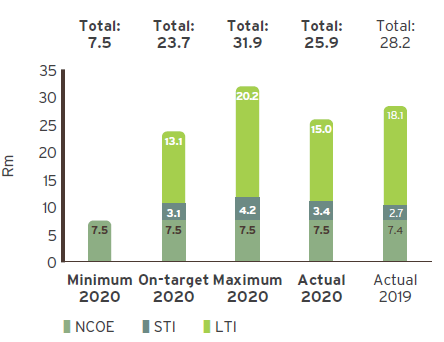
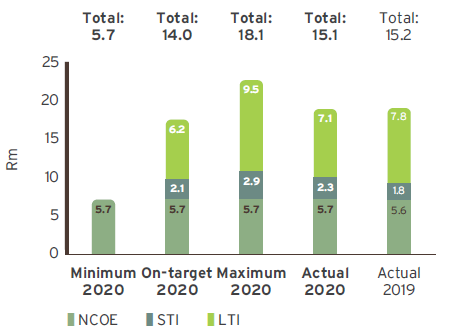
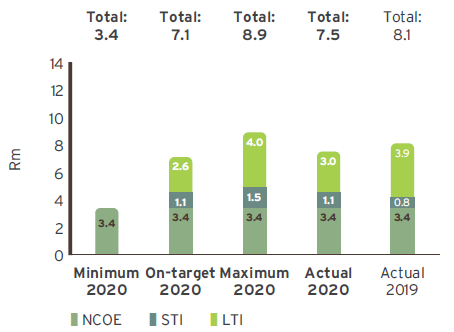
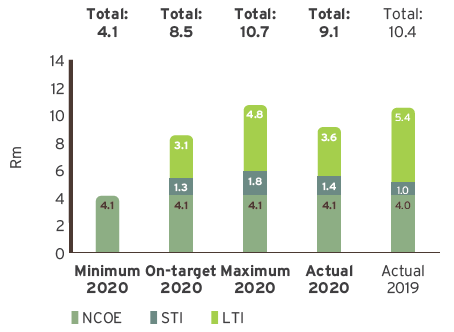
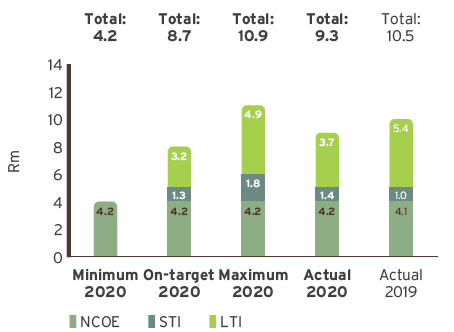
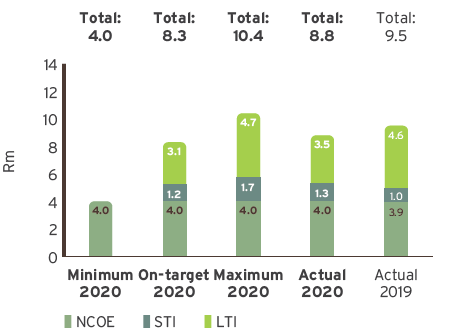
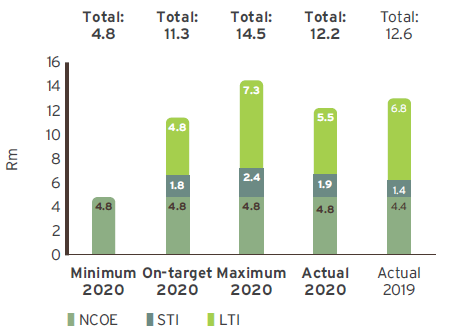
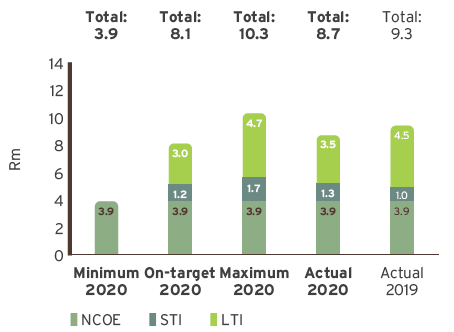
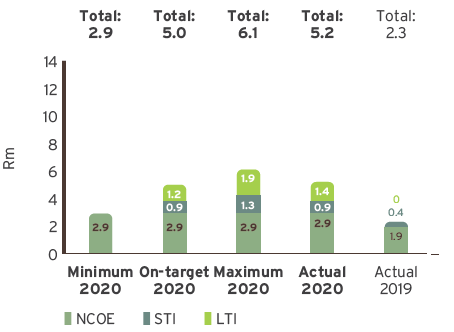
Summary graphs are provided to highlight the impact of performance-based pay on total remuneration due between 2020 - 2019.
The significant increase in 2020 and 2019 total remuneration is explained by the significant increase in the value of the LTIP awards that vested. The share price increased significantly over the period from 1 April 2017 to 31 March 2020. The portion of total remuneration due to STI decreased in 2020 in absolute value as well as percentage when compared to 2019.
The notes below explain the calculations supporting the graphs.
| 1 | Minimum 2020 reflects the NCOE for the period |
| 2 |
Maximum 2020 reflects the sum of the following:
|
| 3 |
On-target 2020 reflects the sum of the following:
|
| 4 |
Actuals for 2020 and 2019:
|
The summary provides insight to the SPR contract outcomes, which resulted in the SPR incentives accrued for 2020.
Objective: Map out horizons in clear objectives to build sustainable core businesses in mining, minerals and energy respectively, specifically in terms of divestments, mergers and acquisitions, strategic partnerships, and non-traditional value proposition.
Outcomes: The CEO developed the refined strategy process for the group, incorporating foresight, objectives, risks and core performance to determine appropriate capital and resource allocation. This will ensure that Exxaro is able to deliver long-term sustainable growth and impact for all our stakeholders. Using this process, we refined the Exxaro strategy and adopted a new vision "resources powering a green world" with a view to growing beyond coal.
Our energy strategy, and refinement of the coal and broader minerals strategy, was developed in alignment with this transition to a low-carbon future. It incorporates key considerations and milestones associated with the TCFD findings and broader Sustainable Growth and Impact strategy objectives.
Some of the already publicised steps supporting the strategy include:
These steps towards the vision and strategic objectives have been shared with stakeholders across various platforms.
Objective: Deliver signed agreement for sale of Leeuwpan and ECC by 31 December 2020 (or amended timeline as approved by the board) within target range proposed to the board in respect of divestment of non-robust assets.
Outcomes: The original target was to sign agreements for Leeuwpan and ECC by the end of December 2020 and or at a time approved by the board. The CEO approached the board in November 2020 and the board approved completion of both transactions in 2021.
Objective: Effective management of COVID-19 response in terms
of the regulatory requirements of the sector and state of
national disaster.
Outcomes: The CEO proactively led the process of developing a
COVID-19 response strategy aimed at limiting infection rate,
hospitalisation and loss of employees. Among numerous responses
unleashed during this period, Exxaro respected and adhered to
government directives and regulations in terms of alert levels
periodically announced by government. In certain instances, the
adopted company measures were largely stricter than government
regulations. Exxaro worked closely with the Mineral Council South
Africa, the Department of Health and neighbouring companies.
Central in these efforts was increasing resources to guarantee
sustainability and resilience so as to limit loss of life, jobs, revenue
and business. The chosen strategic pathways ensured minimal
impact on Exxaro.
Objective: Capital allocation.
Outcomes: Funding for coal mining companies is scarce and
expensive. With Exxaro’s R8 billion facility maturing in 2021 the FD
is overseeing a project to refinance these facilities at competitive
terms and conditions. Good progress has been made and it is
expected that the refinancing will be completed in 1H2021. With the
onset of the uncertainties associated with COVID-19 in 2020, the FD
also ensured that the group was not exposed to liquidity risks. A
short-term facility of R3.75 billion was put in place as a
precautionary measure. In accordance with the group’s capital
allocation framework and free cash flow increasing substantially
after completing the R17 billion expansion programme, shareholder
returns are high on our agenda. With oversight of capital allocation,
the FD revised the group’s dividend policy to include value-accretive
buy-back programmes.
Objective: Implement digital procurement, budgeting and
forecasting strategy to enable more efficient procurement and
financial planning as per agreed project plan).
Outcomes: The FD successful roll-out of the digitalisation
programmes at Grootegeluk, catering for modern financial reporting
and enabling agile decision making with less time and effort. These
programmes were also rolled out at other Exxaro operations.
Standardised, simplified and efficient budgeting and forecasting
processes are now embedded in financial, workforce and capital
expenditure planning areas.
Self-service technology was also successfully implemented in the supply chain environment. This includes guided buying channels improving execution speed, value creation, insight-driven decision making and professional coaching to support impactful sourcing events. The digital procurement platform is the first new cloudbased enterprise resource planning system to be implemented by Exxaro.
Objective: Deliver suitable variable workforce and employment
models for differing requirements of energy and minerals
businesses to enable transitioning at speed and scale and
operationalise the new operating model through structures
with sufficient agility and flexibility to support new business
ventures and divestments, flexible work environments and
decentralised decision making.
Outcomes: Considering our strategy revision, we continue to
review the organisational design principles to reflect fit-for-purpose
design in strategy execution, new ways of working and decision
making. In addition, we are revising employment models for the
future strategy, culture fit and workforce. In defining our design to
transition our workforce, the principles of purpose and performance,
capabilities, structural and learning agility, collaborative
partnerships, inclusivity and autonomy as well as increased
efficiency will guide the enhancement of the Exxaro
employee offering.
Objective: Deliver a financial wellbeing strategy with a specific
focus on alleviating indebtedness of employees and driving
home ownership as a consequence.
Outcomes: Exxaro recognises the importance of enhancing the
health, resilience and wellbeing of our workforce. The effects of
COVID-19 continue to highlight the importance of wellness. To
meet the needs of employees, our focus is on financial wellbeing,
specifically employee indebtedness. Addressing mental strain and
workplace risk, including unsafe behaviour and absenteeism is key.
The long-term plan for financial wellness includes employee
financial awareness training, household budgeting and financial
rehabilitation. Improving the financial health and wellbeing of
employees enables them to pursue positive financial milestones
such as home ownership and education for their families and has a positive impact on society at large. In line with Exxaro culture,
the creation of an enabling environment with adequate mechanisms
for employees to take responsibility for their financial health and
wellbeing.
Objective: Deliver signed agreement for sale of Leeuwpan and
ECC by 31 December 2020 (or amended timeline as approved by
the board) within target range proposed to the board in respect
of divestment of non-robust assets.
Outcomes: The original target was to sign agreements for
Leeuwpan and ECC by the end of December 2020 and/or at a time
approved by the board. The executive approached the board in
November 2020 and the board approved completion of both
transactions in 2021. The board extended finalisation of the sale
of Leeuwpan and ECC from November 2020 to 2021.
Objective: Contribute to the development of the minerals and
services strategy, and develop the technical services model for
consideration by the executive committee (COVID - 19
dependent).
Outcomes: The executive supported the development of an
additional services strategy as part of the overall Exxaro strategy
and objectives of the board and CEO. The services strategy was
presented to the executive and board but was not approved to be
implemented given the current focus on the minerals and energy
strategies of Exxaro. All lessons learned as part of the services
strategy development will be incorporated in the various functional
strategies going forward.
Objective: Manage the project deliverables associated with the
Moranbah South joint venture agreement to reach a "decision
to mine" (COVID-19 dependent).
Outcomes: The executive managed the project deliverables as part
of the agreed scope for the period. These deliverables included the
geoscience exploration strategy and seismic surveys for the
Moranbah South project mining right area. Additional exploration
plans were subsequently developed to enhance the understanding
of the geology model of the project. As part of the early value coal
strategy Exxaro embarked on evaluating three additional open cast
and underground business cases to supplement the overall
Moranbah South long wall project. The timing and exploitation
strategies were developed but will be influenced by geological
definitions and the time to obtain licence to operate requirements.
Objective: Update project processes and procedures to the new
Exxaro 4.0 standard aligning to fourth industrial revolution
principles.
Outcomes: The previous project lifecycle excluded new technology
developments. The executive was revised and updated the new
standards to ensure future Exxaro projects are completed according
to new internal standards and processes. The new project standards
developed included lean construction and building information
modelling guidelines. The fourth industrial revolution principles
were strategically aligned from a functional perspective in terms of
the Digital@Exxaro programme.
Objective: Effective use of relations and channels to share
success stories of social impact targeted at specific
stakeholders as per the stakeholder relations plan and aligned with the Exxaro brand strategy.
Outcomes: A stakeholder survey in 2018 indicated, among others, the
need for Exxaro to be more engaging and communicative with
stakeholders about its activities within communities. The executive
developed a stakeholder communications and public relations plan to address this concern. In 2020, Exxaro built the current platform,
maintaining consistent communication on various digital platforms
about Exxaro’s community and people development activities as well
as key issues with specific stakeholders in the private and public
sectors. Our social media sentiment showed a net positive
improvement from 4% to 15% across various channels.
Objective: Demonstrable actions, plans and outcomes where
Exxaro is creating sustainable economies and accelerating
businesses, participating in a collaborative regional platform
with at least one impact investment project implemented and
another in the pipeline for investment or implementation.
(COVID-19 dependent).
Outcomes: The ESD programme supporting local community SMME
development continued to grow in 2020 despite COVID-19. Exxaro
remains on target to achieve its compliance objective in terms of the
DTIs scorecard level 2. In addition, Exxaro continued to positively
impact SMME growth, focusing our efforts on ensuring the business
continuity for the 67 beneficiary SMMEs in the ESD programme.
Exxaro awarded repayment holidays to 18 candidates to ease cash
constraints and others received additional funding to support business
growth. Exxaro disbursed a total of R79 million, including R18.1 million
in repayment holidays, to preserve approximately 1 300 employment
opportunities and enabled businesses to continue operating in 2021.
The Impact Catalyst, a collaborative regional development initiative,
in partnership with Anglo American, the Council for Scientific and
Industrial Research (CSIR), Zutari and World Vision South Africa,
launched in October 2019, developed several project concepts. Some
began execution in 2020, such as the community-based healthcare
programme.
The executive has signed memoranda of understanding with seven implementers for the development of seven significant impact investment projects. All the impact projects have regional scope in at least three provinces. Exxaro has created a partnership with a multi-faith group, which will support regional engagement.
Objective: Integrate ESD, ECF, SLP and mineral succession
planning, ecosystems to communicate and track impact on
communities during and after mining.
Outcomes: In response to climate change opportunities, we embarked
on the development of a Sustainable Growth and Impact strategy,
which will support the transition of communities dependent on coal
mining operations to a lower-carbon future. This support will be in the
form of enterprise development, repurposing our rehabilitated
landholdings for agriculture and other industry development. The
executive engaged with implementation partners and impact investors
to develop key conceptual plans for several sites. This approach will
integrate existing and new approaches to community development
with impact-investing criteria and enable the participation of thirdparty
funders in sustainable community development opportunities.
Objective: Manage robustness of the Exxaro portfolio by
concluding Moranbah South joint venture agreement to reach
"decision to mine" (COVID-19 dependent).
Outcomes: Over the past year, Exxaro has intensified efforts to
advance the Moranbah South studies and enable an investment
decision. Due to delays in finalising the bankable feasibility study,
Exxaro adopted a revised and more decisive approach that enabled
focused engagement between Exxaro and Anglo American. We
reached an agreement in November 2020, outlining the immediate
process and steps to be followed, and timelines that would help
determine the way forward for both joint venture partners. A
management subcommittee has been constituted, with members
representing Exxaro and Anglo American, to oversee the process and
monitor progress on a monthly basis. Exxaro believes that this
constructive approach is necessary and will lead to more meaningful
progress in work to be done.
Objective: Deliver approved mining and minerals strategy, and
execute initiatives for investment.
Outcomes: Over the years, Exxaro has been a diversified mining
company with indirectly managed equity investments alongside a
good-performing coal business. Exxaro retains its diversified position
by, first and foremost, operating a robust coal portfolio while
maintaining equity investments that make business sense and, from
time to time, explores opportunities presented by other minerals that
could contribute to a decarbonised economy, considering the rapid
energy transition away from fossil fuels. This is in line with Exxaro’s
ambition to be carbon-neutral by 2050.
Objective: Optimise and execute the value of LoM plans for
divestment operations.
Outcomes: This intervention reviews LoM plans, using a zero-based
principle, for Leeuwpan and ECC to identify potential value add
presented by opportunities. In the first half of 2020, an extensive
exercise was undertaken by an external consultant at Leeuwpan and
ECC operations to identify capital investment opportunities and to
quantify the potential value of each opportunity. This exercise
identified short, medium- and long-term interventions that could
release value by increasing throughput or cost savings. The identified
opportunities were incorporated into a revised operational plan and
added in value to performance for the year. The medium- to long-term
opportunities were incorporated into the 2021 operational plan and
2022 to 2025 business plans, which improved net present value for
Leeuwpan and ECC in comparison with the base operational plan due
to improved throughput and cost reductions.

Objective: Optimising the governance model in line with
empowering our people and enabling new ways of working
to enhance agile, quality decision making and increase
accountability at relevant levels within the organisation.
Outcomes: To support the governance model, the company secretary
revised the delegation of authority, and selected policies and processes
in line with the evolving strategy. The board committees’ governance
processes were also reviewed to ensure alignment with agile decision
making, and appropriate risk consideration and mitigation, regarding
the shaping and delivery of the strategy
Objective: Progress against land use plan and strategy to enable
social impact by leasing land to emerging farmers and donating
land to communities.
Outcomes: Exxaro owns vast tracts of land, which places us in afavourable position, given the state of affairs in our communities, to
leverage and repurpose our assets for positive impacts across society.
In the face of ever-increasing levels of unemployment, inequalities and
poverty, Exxaro adopted a deliberate strategy of donating and leasing
land as well as collaborating with other organisations to develop
communal land for the purposes of creating livelihoods in remote
rural areas of the country. This deliberate action aims to ensure a legacy by improving employment opportunities, reducing inequalities
and eradicating poverty in host communities. Exxaro firmly believe
that our future, in terms of sustainability and resilience, is inextricably
linked with efforts to act as catalyst and create parallel economies that
help sustain communities long after mining has ceased.
Objective: Demonstrable actions to reduce environmental impact
and build a cleaner world by reducing paper use and carbon
emissions, improving energy efficiency, driving specific
interventions at mine closures, rehabilitation, with zero level 3
environmental incidents reported.
Outcomes: Exxaro recognises that its business does not exist in
isolation and that it is part of an international community with
guaranteed long-term sustainability by adopting the protocols of the
2016 Paris Agreement. Against this background, Exxaro has embarked
on a robust and deliberate strategy of decarbonisation in line with
South Africa’s commitment to a low-carbon future. Accordingly, Exxaro
introduced digitalisation throughout the company to reduce its carbon
footprint by minimising paper printing and managing rehabilitation
within a digital platform for greater visibility.
Objective: TCFD reporting requirements integrated into group
reporting on sustainability.
Outcome: Climate change presents business risks and opportunities
now and in the future. The TCFD develops recommendations for more
effective climate-related disclosures that could improve investment,
credit and insurance underwriting decisions. In 2019, Exxaro released
its first public climate change statement, which stated its support of
the TCFD and a long-term strategy to reduce carbon emissions. Our
board committed to the publication of a climate change response
strategy outlining Exxaro’s chosen pathway to a low-carbon future.
Objective: Contribute to the development of the Exxaro growth
strategy and transformation including articulation into horizons
with clear milestones, and coordinating strategy communication
and strategic messages with stakeholder affairs.
Outcomes: The executive developed a new strategy process,
integrating foresight, group objectives, risks and core performance
to support capital and resource allocation decisions, positioning Exxaro
to deliver long-term sustainable growth and impact for all stakeholders.
Objective: Embed a robust opportunity review process and
increase the use of foresight to support the strategy planning
process, ensure alignment across the group, and support our
transition to a low-carbon world.
Outcomes: To support current and future growth for Exxaro, and
to protect Exxaro from potential disruption, we have increased our
foresight capabilities. Using a three-horizon model, the executive is
better equipped to anticipate potentials threats and opportunities.
These capabilities are being integrated into the broader strategy
process and integrated risk management framework to support the
achievement of Exxaro’s strategic objectives and associated decision
making across the business.
Exxaro has also defined a rigorous process to filter and assess potential opportunities for growth or operational improvement in alignment with our vision, strategic objectives, and capital return expectations and requirements.
Objective: Build new capabilities in the strategy and business
transformation team.
Outcomes: A key outcome of the strategy review was reconfiguring
Exxaro’s strategic capability. As part of this process, the executive
focused on combining strategy and internal business transformation
into a single area. The executive has strengthened our strategy team
to include new roles and focus areas, and defined new ways of working
to enable agility and alignment with our strategic objectives. Exxaro
has also defined business development as well as mergers and
acquisitions capabilities required to shape and achieve our Sustainable
Growth and Impact strategy across minerals, energy and impact areas.
Objective: Support group implementation and management
of COVID-19 response in terms of the regulatory requirements
of the sector and state of disaster aligned with the strategy of
the business.
Outcomes: The executive provided input and support to the crisis
management team, part of our business continuity management plan,
formed in response to COVID-19. Beyond the operational considerations
and investments, we made to proactively manage the pandemic,
Exxaro contributed to work by Business for South Africa and PwC on
the impacts of COVID-19 in the mining industry.
We also disclose the outcome of the 2018 (and 2017) conditional LTIP awards that vest in April 2021 (and vested in April 2020).
Of the awards made in April 2018, 66.67% vest in April 2021. A summary showing the vesting percentages by vesting conditions for the awards appears in the table below.
Performance vesting conditions outcome
| Performance vesting condition | Weight (%) | 2020 (%) | 2019 (%) |
| HEPS | 33.33 | 100.00 | 100.00 |
| TSR | 33.33 | 0.00 | 100.00 |
| ESG | 33.34 | 100.00 | 76.90 |
| Overall vesting | 66.67 | 92.30 |
| 2020 HEPS was 3 814 cents per share (cps) compared to the maximum vesting (100%) required at 2 775cps. |
| 2019 HEPS was 2 193cps compared to the maximum vesting (100%) required at 1 572cps. |
| 2020 TSR was 0% and positioned 8th (1st Impala Platinum: 64%, 2nd Anglo Platinum: 57%, 3rd Gold Fields: 50%, 4th AngloGold Ashanti: 49%, 5th Sibanye-Stillwater: 42%, 6th Anglo |
| American: 31%, 7th BHP Billiton: 24% and 9th Sasol: -31%). |
| 2019 TSR was 31% and positioned 3rd (1st Anglo Platinum: 45%, 2nd Anglo American: 35%, 4th: AngloGold Ashanti: 28%, 5th BHP Billiton: 27%, 6th Impala Platinum: 22%, 7th Gold Fields: 13%, 8th Mondi: 8%, 9th Sasol: -5% and 10th Sappi: -13%). |
| In both periods, a minimum of 3rd position was required to vest 100% of the TSR portion of awards. |
The environmental component of ESG resulted in an achievement at threshold (30% vesting) due to a total of eight level 2 cases reported over the three-year period:
The table below illustrates the shares held by each participant, shares exercised and shares forfeited due to performance conditions not being met in the review period.
LTIP transaction details for executive directors and prescribed officers in 2020
| Rights held at 31 December Number |
Exercisable period |
Proceeds if exercisable at 31 December1 R |
Pre-tax gain if exercisable at 31 December1 R |
Options exercised during the year Number |
Shares forfeited2 Number |
Sale price/ market price R |
Pre-tax gain R |
Date exercised |
|
| Executive directors | |||||||||
| MDM Mgojo | 01/04/2020 | 136 871 | 11 418 | 99.25 | 13 584 447 | 01/04/2020 | |||
| 161 974 | 01/04/2021 | 22 498 189 | 22 498 189 | ||||||
| 111 942 | 01/04/2022 | 15 548 744 | 15 548 744 | ||||||
| 175 347 | 01/04/2023 | 24 355 698 | 24 355 698 | ||||||
| 449 263 | 62 402 631 | 62 402 631 | 136 871 | 11 418 | 13 584 447 | ||||
| PA Koppeschaar | 01/04/2020 | 59 410 | 4 956 | 99.25 | 5 896 443 | 01/04/2020 | |||
| 76 047 | 01/04/2021 | 10 562 928 | 10 562 928 | ||||||
| 52 605 | 01/04/2022 | 7 306 835 | 7 306 835 | ||||||
| 82 402 | 01/04/2023 | 11 445 638 | 11 445 638 | ||||||
| 211 054 | 29 315 401 | 29 315 401 | 59 410 | 4 956 | 5 896 443 | ||||
| Prescribed officers | |||||||||
| V Balgobind | 01/04/2020 | 26 744 | 2 230 | 99.25 | 2 654 342 | 01/04/2020 | |||
| 32 148 | 01/04/2021 | 4 465 357 | 4 465 357 | ||||||
| 22 218 | 01/04/2022 | 3 086 080 | 3 086 080 | ||||||
| 34 802 | 01/04/2023 | 4 833 998 | 4 833 998 | ||||||
| 89 168 | 12 385 435 | 12 385 435 | 26 744 | 2 230 | 2 654 342 | ||||
| AS de Angelis3 | 14 930 | 01/04/2021 | 2 073 777 | 2 073 777 | |||||
| 14 084 | 01/04/2021 | 1 956 268 | 1 956 268 | ||||||
| 10 366 | 01/04/2022 | 1 439 837 | 1 439 837 | ||||||
| 32 361 | 01/04/2023 | 4 494 943 | 4 494 943 | ||||||
| 71 741 | 9 964 825 | 9 964 825 | – | – | – | ||||
| AW Diedericks | 01/04/2020 | 33 804 | 2 819 | 99.25 | 3 355 047 | 01/04/2020 | |||
| 38 687 | 01/04/2021 | 5 373 624 | 5 373 624 | ||||||
| 26 362 | 01/04/2022 | 3 661 682 | 3 661 682 | ||||||
| 41 293 | 01/04/2023 | 5 735 598 | 5 735 598 | ||||||
| 106 342 | 14 770 904 | 14 770 904 | 33 804 | 2 819 | 3 355 047 | ||||
| JG Meyer | 01/04/2020 | 33 804 | 2 819 | 99.25 | 3 355 047 | 01/04/2020 | |||
| 39 720 | 01/04/2021 | 5 517 108 | 5 517 108 | ||||||
| 27 323 | 01/04/2022 | 3 795 165 | 3 795 165 | ||||||
| 42 798 | 01/04/2023 | 5 944 642 | 5 944 642 | ||||||
| 109 841 | 15 256 915 | 15 256 915 | 33 804 | 2 819 | 3 355 047 | ||||
| MI Mthenjane | 01/04/2020 | 33 181 | 2 767 | 99.25 | 3 293 214 | 01/04/2020 | |||
| 37 975 | 01/04/2021 | 5 274 728 | 5 274 728 | ||||||
| 25 754 | 01/04/2022 | 3 577 231 | 3 577 231 | ||||||
| 40 341 | 01/04/2023 | 5 603 365 | 5 603 365 | ||||||
| 104 070 | 14 455 324 | 14 455 324 | 33 181 | 2 767 | 3 293 214 | ||||
| Dr N Tsengwa | 01/04/2020 | 50 008 | 4 171 | 99.25 | 4 963 294 | 01/04/2020 | |||
| 58 762 | 01/04/2021 | 8 162 042 | 8 162 042 | ||||||
| 40 991 | 01/04/2022 | 5 693 650 | 5 693 650 | ||||||
| 64 208 | 01/04/2023 | 8 918 491 | 8 918 491 | ||||||
| 163 961 | 22 774 183 | 22 774 183 | 50 008 | 4 171 | 4 963 294 | ||||
| SE van Loggerenberg4 | 01/04/2020 | 6 057 | 505 | 99.25 | 601 157 | 01/04/2020 | |||
| 01/10/2020 | 7 043 | 587 | 124.01 | 873 402 | 07/10/2020 | ||||
| 16 187 | 01/04/2021 | 2 248 374 | 2 248 374 | ||||||
| 11 146 | 01/04/2022 | 1 548 179 | 1 548 179 | ||||||
| 17 458 | 01/04/2023 | 2 424 916 | 2 424 916 | ||||||
| 44 791 | 6 221 469 | 6 221 469 | 13 100 | 1 092 | 1 474 559 | ||||
| M Veti | 01/04/2020 | 32 726 | 2 730 | 99.25 | 3 248 056 | 01/04/2020 | |||
| 37 455 | 01/04/2021 | 5 202 500 | 5 202 500 | ||||||
| 25 402 | 01/04/2022 | 3 528 338 | 3 528 338 | ||||||
| 39 790 | 01/04/2023 | 5 526 831 | 5 526 831 | ||||||
| 102 647 | 14 257 669 | 14 257 669 | 32 726 | 2 730 | 3 248 056 | ||||
| 1 | Based on a share price of R138.90 which prevailed on 31 December 2020. |
| 2 | Shares forfeited due to performance conditions not being fully met. |
| 3 | Appointed 1 April 2020. |
| 4 | Resigned on 18 February 2021. |
No further performance conditions apply to this scheme other than continued employment at the time of vesting.
The table below illustrates the shares held by each participant as well as shares exercised and shares forfeited as a result of resignations in the review period.
DBP transaction details for executive directors and prescribed officers in 2020
| Rights held at 31 December Number |
Exercisable period |
Proceeds if exercisable at 31 December1 R |
Pre-tax gain if exercisable at 31 December1 R |
Options exercised during the year Number |
Sale price/ market price R |
Pre-tax gain R |
Date exercised |
|
| Executive directors | ||||||||
| MDM Mgojo | 31/08/2020 | 1 209 | 138.35 | 167 265 | 01/09/2020 | |||
| 4 372 | 09/03/2021 | 607 271 | 607 271 | |||||
| 11 139 | 31/03/2021 | 1 547 207 | 1 547 207 | |||||
| 1 003 | 31/08/2021 | 139 317 | 139 317 | |||||
| 1 414 | 15/03/2022 | 196 405 | 196 405 | |||||
| 8 347 | 31/03/2022 | 1 159 398 | 1 159 398 | |||||
| 12 710 | 31/03/2023 | 1 765 419 | 1 765 419 | |||||
| 1 277 | 31/08/2023 | 177 375 | 177 375 | |||||
| 40 262 | 5 592 392 | 5 592 392 | 1 209 | 167 265 | ||||
| PA Koppeschaar | 732 | 31/08/2021 | 101 675 | 101 675 | ||||
| 5 369 | 31/03/2022 | 745 754 | 745 754 | |||||
| 4 628 | 31/03/2023 | 642 829 | 642 829 | |||||
| 972 | 31/03/2022 | 135 011 | 135 011 | |||||
| 11 701 | 1 625 269 | 1 625 269 | ||||||
| Prescribed officers | ||||||||
| V Balgobind | 09/03/2020 | 1 054 | 104.33 | 109 964 | 24/03/2020 | |||
| 31/03/2020 | 1 891 | 97.81 | 184 959 | 03/04/2020 | ||||
| 31/08/2020 | 303 | 138.35 | 41 920 | 08/09/2020 | ||||
| 1 089 | 09/03/2021 | 151 262 | 151 262 | |||||
| 1 880 | 31/03/2021 | 261 132 | 261 132 | |||||
| 253 | 31/08/2021 | 35 142 | 35 142 | |||||
| 351 | 15/03/2022 | 48 754 | 48 754 | |||||
| 2 540 | 31/03/2022 | 352 806 | 352 806 | |||||
| 2 170 | 31/03/2023 | 301 413 | 301 413 | |||||
| 8 283 | 1 150 509 | 1 150 509 | 3 248 | 336 843 | ||||
| AS de Angelis | 1 057 | 31/03/2023 | 146 817 | 146 817 | ||||
| 451 | 31/08/2023 | 62 644 | 62 644 | |||||
| 1 508 | 209 461 | 209 461 | ||||||
| AW Diedericks | 09/03/2020 | 2 406 | 104.33 | 251 018 | 18/03/2020 | |||
| 31/03/2020 | 4 368 | 97.81 | 427 234 | 01/04/2020 | ||||
| 31/08/2020 | 688 | 138.35 | 95 185 | 31/08/2020 | ||||
| 2 484 | 09/03/2021 | 345 028 | 345 028 | |||||
| 4 287 | 31/03/2021 | 595 464 | 595 464 | |||||
| 557 | 31/08/2021 | 77 367 | 77 367 | |||||
| 773 | 15/03/2022 | 107 370 | 107 370 | |||||
| 3 098 | 31/03/2022 | 430 312 | 430 312 | |||||
| 4 641 | 31/03/2023 | 644 635 | 644 635 | |||||
| 690 | 31/08/2023 | 95 841 | 95 841 | |||||
| 16 530 | 2 296 017 | 2 296 017 | 7 462 | 773 437 | ||||
| JG Meyer | 09/03/2020 | 2 413 | 104.33 | 251 748 | 16/03/2020 | |||
| 31/03/2020 | 4 375 | 97.81 | 427 919 | 01/04/2020 | ||||
| 31/08/2020 | 688 | 138.35 | 95 185 | 02/09/2020 | ||||
| 4 786 | 31/03/2023 | 664 775 | 664 775 | |||||
| 4 786 | 664 775 | 664 775 | 7 476 | 774 852 | ||||
| MI Mthenjane | 09/03/2020 | 1 304 | 104.33 | 136 046 | 24/03/2020 | |||
| 31/08/2020 | 670 | 138.35 | 92 695 | 08/09/2020 | ||||
| 1 346 | 09/03/2021 | 186 959 | 186 959 | |||||
| 2 331 | 31/03/2021 | 323 776 | 323 776 | |||||
| 3 677 | 510 735 | 510 735 | 1 974 | 228 741 | ||||
| Dr N Tsengwa | 09/03/2020 | 1 308 | 104.33 | 136 464 | 18/03/2020 | |||
| 31/08/2020 | 396 | 138.35 | 54 787 | 09/09/2020 | ||||
| 265 | 31/08/2021 | 36 809 | 36 809 | |||||
| 519 | 15/03/2022 | 72 089 | 72 089 | |||||
| 2 359 | 31/03/2022 | 327 665 | 327 665 | |||||
| 418 | 31/08/2023 | 58 060 | 58 060 | |||||
| 3 561 | 494 623 | 494 623 | 1 704 | 191 251 | ||||
| M Veti | 09/03/2020 | 1 271 | 104.33 | 132 603 | 23/03/2020 | |||
| 31/08/2020 | 369 | 138.35 | 51 051 | 07/09/2020 | ||||
| 1 326 | 09/03/2021 | 184 181 | 184 181 | |||||
| 2 314 | 31/03/2021 | 321 415 | 321 415 | |||||
| 302 | 31/08/2021 | 41 948 | 41 948 | |||||
| 419 | 15/03/2022 | 58 199 | 58 199 | |||||
| 1 675 | 31/03/2022 | 232 658 | 232 658 | |||||
| 660 | 31/08/2023 | 91 674 | 91 674 | |||||
| 6 696 | 930 075 | 930 075 | 1 640 | 183 654 | ||||
| 1 | Based on a share price of R138.90 which prevailed on 31 December 2020. |
DBP income for executive directors and prescribed officers
| Executive director and prescribed officers | DBP shares held as a percentage of NCOE at 31 December 2020 |
DBP shares held at 31 December 2020 |
2017 DBP shares matched | ||
| % | R | Number | R | Number | |
| MDM Mgojo | 74 | 5 592 392 | 40 262 | 167 265 | 1 209 |
|---|---|---|---|---|---|
| PA Koppeschaar | 28 | 1 625 269 | 11 701 | ||
| V Balgobind | 34 | 1 150 509 | 8 283 | 336 843 | 3 248 |
| AS de Angelis | 7 | 209 461 | 1 508 | ||
| AW Diedericks | 57 | 2 296 017 | 16 530 | 773 437 | 7 462 |
| JG Meyer | 16 | 664 775 | 4 786 | 774 852 | 7 476 |
| MI Mthenjane | 13 | 510 735 | 3 677 | 228 741 | 1 974 |
| Dr N Tsengwa | 10 | 494 623 | 3 561 | 191 251 | 1 704 |
| M Veti | 24 | 930 075 | 6 696 | 183 654 | 1 640 |
The total single figure remuneration for executive directors and prescribed officers is stated in the table below to align with King IV disclosure. The 2020 LTIP reflected the 1 April 2017 LTIP award that will vest as a result of 2020 performance on 1 April 2020. Since the portion of the DBP voluntary deferral is included under the STIs, proceeds from the matched portion of the DBPs are reflected under LTIs.
Single figure remuneration as per King IV for 2020 and 2019
| Year | NCOE R |
Recognition and other payments R |
STIs R |
LTIs R |
Total remuneration R |
|
| Executive directors | ||||||
| MDM Mgojo | 2020 | 7 533 816 | 141 586 | 3 415 080 | 15 040 578 | 26 131 060 |
|---|---|---|---|---|---|---|
| 2019 | 7 410 601 | 5 260 | 2 741 922 | 18 107 777 | 28 265 560 | |
| PA Koppeschaar | 2020 | 5 719 117 | 2 500 | 2 306 522 | 7 061 571 | 15 089 710 |
| 2019 | 5 624 332 | 5 260 | 1 799 786 | 7 791 003 | 15 220 381 | |
| Prescribed officers | ||||||
| V Balgobind | 2020 | 3 419 820 | 14 338 | 1 054 332 | 2 985 199 | 7 473 689 |
| 2019 | 3 363 889 | 5 260 | 840 972 | 3 933 020 | 8 143 141 | |
| AS de Angelis | 2020 | 2 915 100 | 2 500 | 945 100 | 1 386 371 | 5 249 071 |
| 2019 | 1 865 891 | 50 099 | 416 683 | 2 332 673 | ||
| AW Diedericks | 2020 | 4 057 728 | 2 500 | 1 352 442 | 3 592 398 | 9 005 068 |
| 2019 | 4 004 844 | 5 260 | 1 001 211 | 5 411 496 | 10 422 811 | |
| JG Meyer | 2020 | 4 205 568 | 2 500 | 1 401 716 | 3 688 320 | 9 298 104 |
| 2019 | 4 141 399 | 5 260 | 1 035 350 | 5 413 332 | 10 595 341 | |
| MI Mthenjane | 2020 | 3 964 176 | 2 500 | 1 321 260 | 3 526 283 | 8 814 219 |
| 2019 | 3 916 983 | 55 575 | 979 246 | 4 610 097 | 9 561 901 | |
| Dr N Tsengwa | 2020 | 4 788 451 | 2 500 | 1 931 182 | 5 456 521 | 12 178 654 |
| 2019 | 4 373 844 | 10 760 | 1 399 630 | 6 781 408 | 12 565 642 | |
| SE van Loggerenberg | 2020 | 2 263 300 | 2 500 | 595 928 | 1 503 093 | 4 364 821 |
| 2019 | 2 244 531 | 10 760 | 448 906 | 1 717 831 | 4 422 028 | |
| M Veti | 2020 | 3 909 972 | 2 500 | 1 303 196 | 3 477 996 | 8 693 664 |
| 2019 | 3 863 424 | 5 260 | 965 856 | 4 506 743 | 9 341 283 | |
The STIs are inclusive of the voluntary individual deferral made for 2020. The LTIs reflects 66.67% of the April 2018 award that will vest on 1 April 2021 at 31 December 2020 volume weighted average share price of R139.28.
For 2020
An amount of R2 500 includes fatality free recognition payment. Leave encashment amounts are included for MDM Mgojo: R139 086 and V Balgobind: R11 838.
For 2019
An amount of R5 260 includes fatality free recognition payment and R2 760 for LTIFR recognition. An additional total amount of R10 760 for suggestion award was received by Dr N Tsengwa and SE van Loggerenberg. Leave encashment of R50 315 for M Mthenjane is included.
| 2020 | 2019 | |||||
| Fees for services R |
Benefits and allowances R |
Total R |
Fees for services R |
Benefits and allowances R |
Total R |
|
| Non-executive directors | ||||||
| GJ Fraser-Moleketi | 1 162 496 | 1 162 496 | 938 235 | 5 478 | 943 713 | |
|---|---|---|---|---|---|---|
| L Mbatha | 582 337 | 582 337 | 702 899 | – | 702 899 | |
| VZ Mntambo | 728 933 | 728 933 | 638 068 | – | 638 068 | |
| MJ Moffett | 933 861 | 933 861 | 923 063 | – | 923 063 | |
| LI Mophatlane | 819 174 | 819 174 | 1 045 616 | 2 913 | 1 048 529 | |
| EJ Myburgh | 1 229 321 | 1 229 321 | 1 168 912 | – | 1 168 912 | |
| V Nkonyeni | 959 545 | 2 059 | 961 604 | 956 784 | 21 879 | 978 663 |
| J van Rooyen (chairperson) | 2 128 588 | 2 128 588 | 2 016 072 | – | 2 016 072 | |
| A Sing1 | 294 136 | 294 136 | 787 867 | – | 787 867 | |
| PCCH Snyders | 879 159 | 1 067 | 880 226 | 1 041 060 | 55 472 | 1 096 532 |
| Total non-executive directors' remuneration | 9 717 550 | 3 126 | 9 720 676 | 11 233 404 | 85 742 | 11 319 146 |
| 1 | Retired on 28 May 2020. |


